
Close Menu
HFG Insider

    Subscribe to Updates

    Get the latest creative news from FooBar about art, design and business.

    What's Hot

    The only place in India where no one worships Lord Hanuman and there is no temple dedicated to him

    October 19, 2026

    Asian Para Games: Kokila assures India of judo medal, sets up gold-medal clash | Asian Para Games 2026 News

    October 19, 2026

    England put £25 million into 20 nature projects in 2024; two years later, they had improved 4,800 hectares, planted 127,500 trees and beaten the programme’s habitat target by nearly 30%

    October 19, 2026
    Facebook X (Twitter) Instagram
    Trending
    • The only place in India where no one worships Lord Hanuman and there is no temple dedicated to him
    • Asian Para Games: Kokila assures India of judo medal, sets up gold-medal clash | Asian Para Games 2026 News
    • England put £25 million into 20 nature projects in 2024; two years later, they had improved 4,800 hectares, planted 127,500 trees and beaten the programme’s habitat target by nearly 30%
    • Rpsc Senior Teacher Result Download: RPSC 2nd Grade Teacher result 2026 out for Science; document verification to begin: Direct link to download scorecards here
    • Timothee Chalamet cheers for girlfriend Kylie Jenner as she makes Victoria’s Secret Fashion Show debut in USD 50 million Fantasy Bra |
    • Baby names inspired by Maha Navami: Meaningful names for boys and girls that reflect divine blessings, strength, courage and the festive spirit of this auspicious occasion
    • Watch: Kylian Mbappé’s sensational turn, quick touch and brilliant finish for Real Madrid | Football News
    • France counts cost of worst unrest in years as tensions flare again in Paris
    Facebook Instagram Pinterest YouTube Tumblr Bluesky Threads
    HFG Insider
    Subscribe Buy Now
    Monday, October 19
    • Home
    • Education
    • Entertainment
    • Environment
    • Sports
    • Tech
    • World
    • Lifestyle
    • Contact Us
    • About Us
    HFG Insider
    Home»World»A 324-million-year-old fossil reveals an early insect with paddle-like limbs that lived between water and land before insects conquered Earth |
    World

    A 324-million-year-old fossil reveals an early insect with paddle-like limbs that lived between water and land before insects conquered Earth |

    HFG INSIDER 897By HFG INSIDER 897September 1, 2026No Comments5 Mins Read
    Facebook Twitter Pinterest LinkedIn Tumblr Email
    Share
    Facebook Twitter LinkedIn Pinterest Email Copy Link


    A 324-million-year-old fossil reveals an early insect with paddle-like limbs that lived between water and land before insects conquered Earth
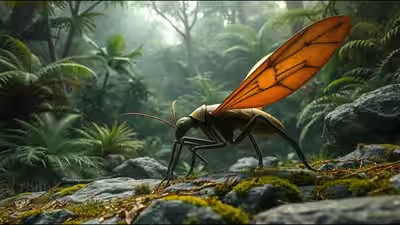
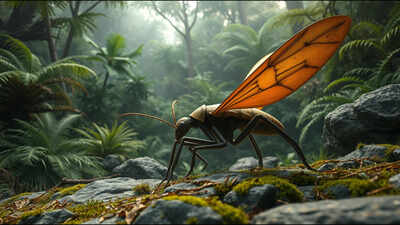
    Representative Image of Chosha praecursor, an early insect with paddle-like abdominal appendages in a prehistoric landscape (AI-generated image)

    Today, insects occupy nearly every terrestrial environment on Earth and account for more described species than any other animal group, yet the earliest stages of their evolutionary history remain poorly documented. A newly described species from western Texas, named Chosha praecursor, now offers a rare glimpse into that missing chapter. The animal lived roughly 324 million years ago during the Late Mississippian and combined recognisably insect-like anatomy with a body plan unlike that of any living insect. It had three pairs of thoracic walking legs, but its abdomen retained segmented appendages across all nine abdominal segments, with the posterior ones modified into broad, paddle-like structures. The anatomy, combined with evidence that the animal lived in a near-shore, shallow-water environment, suggests a semi-aquatic lifestyle. Rather than showing an insect that had already completed the transition to life on land, the fossil provides evidence that some early insects retained and modified ancestral aquatic structures while adapting to humid environments at the boundary between water and land.

    Read moreFrench proverb of the day: 'Little by little, the bird makes its nest' — a lesson on why slow, steady effort builds the strongest foundations

    Why the fossil record has an 80-million-year gap in early insect history

    According to the study titled Amphibious stem-insect sheds light on colonization of land, led by Chenyang Cai of the Nanjing Institute of Geology and Palaeontology and Erik Tihelka of the University of Cambridge and published in Nature, the early evolutionary history of insects falls partly within what palaeontologists call the “hexapod gap.” Molecular-clock estimates place the divergence and early diversification of hexapods considerably earlier than the oldest globally undisputed hexapod body fossils, which come from the Early Devonian Rhynie Chert in Scotland at about 405 million years ago. Unambiguous insect fossils also do not become abundant until much later in the Carboniferous. The result is a roughly 80-million-year interval in which the fossil evidence for early hexapod evolution is extremely sparse. Chosha praecursor, dating to about 324 million years ago, does not fill that entire chronological gap, but it provides important evidence about what early-diverging insects looked like and how they may have lived. The study also revises the identities and relationships of several other enigmatic Palaeozoic hexapod fossils, revealing that early wingless insects had a much greater diversity of body forms than their modern descendants.

    Read moreAt least 9 killed as Russia launches fresh attacks across Ukraine's Dnipro, Zaporizhzhia

    How researchers identified Chosha praecursor after decades of misclassification

    The fossils were recovered from calcareous claystone concretions in the Tesnus Formation of the Marathon Uplift in western Texas. The material had previously been interpreted as crustacean larvae, but researchers re-examined it using cross-polarised light imaging, which revealed anatomical details that were difficult to distinguish from the dark surrounding rock. The specimens represent adult females with a body length of 32.09 millimetres, extending to 49.66 millimetres when the terminal filament and two cerci are included. Their anatomy combines features diagnostic of insects with more primitive characteristics. The thorax bears three pairs of walking legs, while the animal also possesses an ovipositor and a terminal caudal filament, both important insect characteristics. The abdomen, however, is strikingly different from that of modern insects: segments one through nine each carry segmented appendages, giving the animal 18 additional abdominal limbs alongside its six thoracic walking legs. The posterior abdominal appendages are modified into paddle-like structures. Phylogenetic analysis places Chosha within the hexapod lineage and strongly favours its position as an early-diverging stem-group insect rather than a crustacean.

    Why abdominal paddles point to a life lived between water and land

    The most revealing structures on Chosha are the abdominal appendages. Modern crown-group insects have lost comparable abdominal limbs and retain their three pairs of walking legs on the thorax. Chosha, by contrast, retained appendages across all nine abdominal segments, with the posterior ones modified into flattened, paddle-like structures. The researchers describe these unusual structures as having gill-like characteristics and interpret them, together with the geological setting, as evidence for a semi-aquatic lifestyle. The fossils were preserved in sediments representing near-shore, shallow-water deltaic and coastal environments, suggesting that the animal occupied humid habitats along the boundary between aquatic and terrestrial ecosystems. Its anatomy indicates that it was not simply a fully aquatic arthropod that happened to resemble an insect: it already possessed the three pairs of thoracic walking legs, an ovipositor and other features associated with insects. The researchers therefore interpret Chosha as evidence that at least some early stem-insects lived in amphibious environments while retaining ancestral structures associated with aquatic life. They also propose that these early insects may have fed on humus, plant detritus and fungal spores, potentially making them both consumers and decomposers within developing aquatic-terrestrial ecosystems.

    What the loss of abdominal limbs reveals about how the modern insect body evolved

    The significance of Chosha lies in showing that the familiar six-legged insect body plan was not necessarily assembled all at once. The fossil demonstrates that an early-diverging insect could already possess the characteristic three pairs of thoracic walking legs and specialised structures such as an ovipositor while retaining a series of abdominal appendages that have disappeared from living insects. The researchers argue that insect terrestrialization was a gradual process involving the retention, remodelling and eventual reduction of ancestral aquatic structures. In that interpretation, the transition to life on land was not a single evolutionary leap but a prolonged period during which early insects occupied environments along the water-land boundary. The researchers’ re-examination of other Palaeozoic stem-group fossils, including Leverhulmia from the Devonian of Scotland and enigmatic Carboniferous hexapods from the Mazon Creek Lagerstätte in Illinois, further suggests that early insects possessed a diversity of body organisations that has largely disappeared. Chosha therefore provides a rare snapshot of an evolutionary stage in which insect-like anatomy and aquatic adaptations existed together, helping researchers reconstruct how the modern insect body plan emerged from more anatomically complex ancestors.


    Source link

    Share. Facebook Twitter Pinterest LinkedIn Tumblr Email
    Previous ArticleUGC NET June 2026 re-exam city intimation slip released at ugcnet.nta.nic.in: Direct link to download here
    Next Article Random Musing: Should Novak Djokovic take a leaf from Lionel Messi and retire? | Tennis News
    HFG INSIDER 897
    • Website
    • Facebook
    • Pinterest
    • Instagram
    • Tumblr

    HFG Insider is your daily source for the latest News, Technology, Sports, Business, Health, Entertainment, and more. Stay informed with timely updates, trending stories, important developments, and engaging content from India and around the world all in one place.

    Related Posts

    World

    England put £25 million into 20 nature projects in 2024; two years later, they had improved 4,800 hectares, planted 127,500 trees and beaten the programme’s habitat target by nearly 30%

    By HFG INSIDER 897October 19, 2026
    World

    France counts cost of worst unrest in years as tensions flare again in Paris

    By HFG INSIDER 897October 19, 2026
    World

    Muizzu begins 3-day Pak visit tomorrow, 1st Maldives prez trip in over a decade

    By HFG INSIDER 897October 19, 2026
    World

    In 2023, restoration began on 150 acres of California floodplain with more than 30,000 native plants; three years later, Swainson’s hawks have nested in Shasta County for the first confirmed time in about 30 years

    By HFG INSIDER 897October 19, 2026
    World

    People paid to clear their criminal records but allegedly received forged court orders; after a three-year investigation, an Indiana law firm employee faces 42 felony charges and three misdemeanors

    By HFG INSIDER 897October 19, 2026
    World

    John Legend gave $500,000 to help restore a school auditorium in his Ohio hometown; a decade after opening, the 680-seat theatre hosts youth concerts and is home to Springfield’s jazz orchestra

    By HFG INSIDER 897October 19, 2026
    Add A Comment
    Leave A Reply Cancel Reply

    Don't Miss

    The only place in India where no one worships Lord Hanuman and there is no temple dedicated to him

    By HFG INSIDER 897October 19, 2026

    In a country where Hanuman is not just worshipped as a deity but is an…

    Asian Para Games: Kokila assures India of judo medal, sets up gold-medal clash | Asian Para Games 2026 News

    October 19, 2026

    England put £25 million into 20 nature projects in 2024; two years later, they had improved 4,800 hectares, planted 127,500 trees and beaten the programme’s habitat target by nearly 30%

    October 19, 2026

    Rpsc Senior Teacher Result Download: RPSC 2nd Grade Teacher result 2026 out for Science; document verification to begin: Direct link to download scorecards here

    October 19, 2026

    HFG Insider is your daily source for the latest News, Technology, Sports, Business, Health, Entertainment, and more. Stay informed with timely updates, trending stories, important developments, and engaging content from India and around the world — all in one place.

    HFG Insider | Stay Informed. Stay Ahead.

    Facebook Instagram Pinterest YouTube Tumblr Bluesky Threads
    Our Picks

    The only place in India where no one worships Lord Hanuman and there is no temple dedicated to him

    October 19, 2026

    Asian Para Games: Kokila assures India of judo medal, sets up gold-medal clash | Asian Para Games 2026 News

    October 19, 2026

    England put £25 million into 20 nature projects in 2024; two years later, they had improved 4,800 hectares, planted 127,500 trees and beaten the programme’s habitat target by nearly 30%

    October 19, 2026
    Categories
    • Education
    • Entertainment
    • Environment
    • Lifestyle
    • Sports
    • Tech
    • World
    • Terms and Conditions
    • Privacy Policy
    • Contact Us
    • About Us
    © 2026 HFG INSIDER. All Rights Reserved.

    Type above and press Enter to search. Press Esc to cancel.