





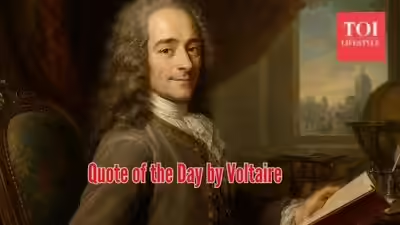

Voltaire was one of the most famous thinkers of the middle ages. He was one of the few thinkers to have a major impact on the modern world. He was a fearless writer, philosopher, historian and social critic who dedicated his life to fighting injustice, religious intolerance and the abuse of power. His wit was legendary, his pen was feared by kings and priests and his ideas became one of the intellectual foundations of democracy, freedom of speech and human rights. His works continue to be debated today more than two hundred years after his death over liberty and authority.He is often quoted as saying, “If you want to know who controls you, look at who you are not allowed to criticize.” The quote is often shared online, but there is no reliable historical evidence that Voltaire actually wrote or said it. This seems to be a modern quotation in his philosophy spirit, not directly. But the feeling is very much in line with many of the principles he defended all his life.Early YearsFrançois-Marie Arouet, known as Voltaire, was born in Paris, France on 21 November 1694. His father had wanted him to follow a respectable career in law, but young François was attracted to literature, satire and intellectual debate. In his student days, he had shown a sharp wit and a talent for poking holes in authority with a clever pen. In Voltaire’s youth France was ruled by an absolute monarchy in close partnership with the Catholic Church. Either institution could be punished by imprisonment or exile if criticised. But the restrictions only made Voltaire more eager to speak his mind.His sharp tongue soon got him into trouble. In 1717 he was imprisoned in the Bastille for nearly a year for writing satirical verses about the French government. Imprisonment did not silence him. It only confirmed his belief that ideas could not be locked away. During this period he took upon himself the name of Voltaire, by which history knows him.Exile in England Another confrontation with a French nobleman in 1726 forced Voltaire to exile in England. It changed his whole outlook on life. In large measure England possessed what France lacked, a somewhat greater measure of freedom of expression, constitutional government, diversity of religion, and freedom of scientific inquiry. Voltaire admired the writings of philosophers such as John Locke and the discoveries of Isaac Newton. He was fascinated by a society where public debate was freer and where the monarchy was limited by law.He wrote ‘Letters on the English’ praising the English for their political and religious freedoms on his return to France. French authorities banned the book and ordered copies to be burnt, considering it a danger. Once again Voltaire was at odds with authority.Advocate of ReasonVoltaire became one of the most prominent spokesmen of the Enlightenment, an intellectual movement that placed reason, science, education, and individual liberty above superstition and unquestioned authority. He believed that human progress rested on asking hard questions, not on taking tradition at face value. He wrote on philosophy, history, science, politics, religion and literature and was one of the most versatile writers of his time.His most renowned works include Candide (1759), a satirical novel which mocked blind optimism and exposed the cruelty, hypocrisy and irrationality of society. Voltaire used humour and irony to stimulate critical thinking, not to lull us into comfortable illusions.Perhaps Voltaire’s greatest contribution was not in writing books but in actively defending the victims of injustice. A famous example was that of Jean Calas, a Protestant merchant falsely accused of murdering his own son. Calas was tortured and executed on flimsy evidence because of religious prejudice. Voltaire waged an incessant campaign to expose the miscarriage of justice. Through letters, essays and public pressure, he persuaded the authorities to re-examine the case. Years later, Calas was officially cleared. The episode helped cement Voltaire’s reputation as a defender of civil liberties and religious tolerance.His attitude towards religionIt is often said that Voltaire was against religion as such. Indeed, he opposed religious fanaticism, intolerance and the abuse of power by institutions. He believed in a creator, but he rejected much of the doctrine of organised religion. His famous slogan, ‘Écrasez l’infâme’ (‘Crush the infamous thing’) was not directed at faith itself but to oppression, superstition and religious persecution. He said no religion should be allowed to silence criticism or dominate public life.Impact on the Modern WorldVoltaire’s influence was felt far beyond France. He died in 1778, before the start of the French Revolution, but his ideas were an inspiration for it. His writings also encouraged democratic movements throughout Europe and North America by advocating freedom of thought, equality before the law, and protection of individual rights.Many of the ideas promoted by Enlightenment thinkers such as Voltaire are embodied in principles that are now seen as fundamental to democratic societies . These include freedom of speech , freedom of religion , independent courts and limits on government power . His legacy remains relevant to modern debates about censorship, civil liberties and intellectual freedom.Quote of the DayOne of the most iconic quotes of Voltaire with a very deep meaning is, “Are you a bore without knowing about it? The secret of being a bore is to tell everything.”Voltaire’s comment, on the surface, seems to be a humorous one, as if a clever and amusing quip. But its simplicity holds a timeless lesson on communication, wisdom, human psychology and social intelligence. Voltaire is not criticising those who talk too much, but rather alluding to a deep truth: the worth of communication is not the number of words spoken, but the wisdom of what is not spoken. Speaking with restraint, curiosity and purpose often leaves a much stronger impression than trying to share every thought, fact or experience.The quote suggests that one of the fastest ways to turn people off is to think that every detail needs to be vocalised. Some people have a need to explain everything they know, to tell you every detail of every event, or just to talk endlessly about everything. They may want to be helpful, knowledgeable or entertaining, but often they end up the opposite. The conversation leaves little room for imagination, participation or discovery and listeners get overwhelmed, distracted or disengaged.Voltaire knew that conversation is not a lecture but a give-and-take. The best communicators are seldom the ones who talk the most. They are the ones who know when to stop talking, when to listen, and when to let others talk. The quote also applies to an important principle of human curiosity. Mystery and incompleteness are attractive to people naturally. What makes stories interesting is that they don’t tell us everything right away, they tell us little by little. Good writers tell you the right information at the right time so you can guess what is going to happen next. Good teachers make students think rather than giving them all the answers. Great leaders are great communicators, but they don’t drown people in unnecessary detail.This is not only a storytelling principle. In day-to-day life, conversations are more meaningful when people make room for questions. Sharing every opinion, every memory, every piece of information can accidentally shut the door to real dialogue. Voltaire’s insight also highlights the importance of listening. Those who feel the need to explain everything, don’t usually spend much time listening to others. They may not notice whether their audience is interested, confused, or ready to jump in. To communicate truly, you need as much awareness of the person you’re speaking to as confidence in yourself. Those who listen well learn a lot more than those who are always talking.Humility is another part of the quote. People like to share what they know, what they have done and what they have experienced. But there is a fine line between sharing information and trying to show off one’s intelligence. He who would show how much he knows may appear not wise but self-important, though he may not mean it. Whereas truly knowledgeable people tend to explain ideas simply, answer questions thoughtfully and realise that they don’t have to prove their intelligence in every conversation.This idea is even more pertinent in the digital age. Social media forces people into constant sharing – opinions on every news story, updates on their day-to-day lives, endless explanations, instant reactions. Information sharing can be very useful but the pressure to comment on everything can create noise rather than meaningful discussion. As Voltaire said, not every thought should be expressed, and not every conversation needs to be over-explained.The quote also shows the power of brevity. Surprisingly, some of history’s most influential speeches, books and quotes have been short. Great ideas are sometimes made stronger by brevity rather than length. But when speakers concentrate on their main point, rather than every possible detail, their audience is more likely to remember and think about what they heard.That is not to say that detailed explanations are always unwelcome. Depending on the situation, scientists, historians, teachers, lawyers, and doctors often have to convey a lot of information. The lesson is to know when detail adds to understanding and when it is just the speaker’s desire to go on. The wise man discerns.There is also a psychological insight in the quotation. Those who dominate conversations often think they’re improving relationships by sharing all about themselves. In fact, meaningful relationships are built on mutual exchange. Friendships. Families. Work partnerships. When people have the opportunity to speak, ask questions and be heard, they thrive. Sometimes leaving space for others is more respectful than filling every silence.Voltaire also reminds us that silence has its own value. In contemporary life silence is uncomfortable and awkward, and people are taught to fill every gap in conversation with words. Yet silence permits reflection. It gives the listener time to digest ideas and the speaker time to choose his words. Wise people throughout history have known that thoughtful pauses can signal confidence, patience and self control.A further important message is that shared knowledge is of greater value when it is shared with purpose. It’s not enough to just have information to be interesting. The key is choosing the right information for the right audience at the right time. A great speaker isn’t someone who knows everything, it’s someone who knows what people actually want or need to hear.Voltaire’s wit has an eternal truth: the ones who spoke the most are rarely remembered. They remember those who thought, who listened with sincerity, and who understood that wisdom often lies not in uttering all things, but in knowing what is really necessary to utter.