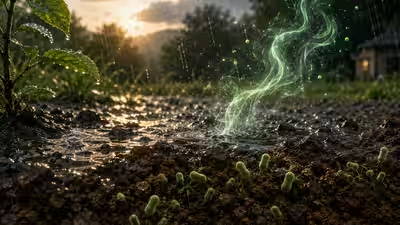

Few natural experiences are as universally loved as the earthy scent that rises after the first drops of rain hit dry ground. Petrichor, what most people describe as the smell of fresh rain, but the rain itself has almost no scent. Instead, what your nose detects is a remarkable chemical called geosmin, produced by soil-dwelling bacteria that have been shaping Earth’s ecosystems for hundreds of millions of years.The primary source of geosmin is a group of filamentous bacteria known as Streptomyces. These microbes thrive in soil, where they help break down dead plants and other organic matter, recycling nutrients back into the environment. Long before the first dinosaurs appeared around 230 million years ago, the ancestors of these bacteria were already flourishing on Earth. Every rainfall simply releases the compounds they have been quietly producing all along, creating one of nature’s most recognisable aromas.
The science behind petrichor, the smell of rain
The pleasant smell after rain is commonly known as petrichor, a term coined in 1964 by Australian researchers Isabel Joy Bear and Richard G. Thomas. They discovered that during dry weather, plants release oils that accumulate on rocks and soil. When rain arrives, these oils mix with geosmin and other organic compounds, producing the distinctive fragrance associated with fresh rainfall.As raindrops strike porous surfaces, they trap tiny air bubbles that burst back into the atmosphere, carrying microscopic aerosol particles containing geosmin and plant oils. These invisible droplets are then transported by the wind, allowing people to smell rain even before a shower reaches them.The intensity of petrichor often depends on rainfall conditions. Light rain after a prolonged dry spell usually produces the strongest scent because more geosmin and plant-derived compounds have accumulated on the soil surface.
Meet Streptomyces: The ancient bacteria responsible for Earth’s earthy aroma
Although bacteria are often associated with disease, Streptomyces are among the most beneficial microorganisms on the planet. They belong to a group called actinobacteria and are found in soils across every continent.According to researchers from the Institute of Microbiology, Rutgers, The State University, their main role is to decompose complex organic material such as leaves, wood and roots that many other organisms cannot easily digest. By recycling these materials, they enrich the soil and support healthy plant growth.In 1965, researchers isolated geosmin, the compound responsible for this characteristic smell, from soil-dwelling actinomycetes, particularly Streptomyces. They found that these bacteria naturally produce geosmin as part of their metabolism, with Streptomyces griseus identified as one of the species capable of generating the compound under laboratory conditions. This landmark discovery established that the familiar scent of wet earth originates not from rain itself, but from microscopic organisms living in the soil.These bacteria also have another extraordinary talent: they produce many of the antibiotics used in modern medicine. More than two-thirds of naturally derived antibiotics, including streptomycin, tetracycline, chloramphenicol and erythromycin, originated from Streptomyces species. Scientists continue to study them in the search for new medicines capable of fighting antibiotic-resistant bacteria.Geosmin itself is produced as part of the bacteria’s life cycle, particularly when they form spores that can spread through the environment.
Humans can detect geosmin at astonishingly low concentrations
One reason the smell of rain feels so powerful is that the human nose is exceptionally sensitive to geosmin. Researchers have shown that people can detect it at concentrations of just a few parts per trillion, equivalent to sensing a tiny drop diluted into an Olympic-sized swimming pool.Scientists believe this sensitivity may have offered an evolutionary advantage. For early humans and many other animals, detecting geosmin could have helped locate fresh water or identify healthy, biologically active soils after rainfall.Not every species responds the same way, however. While humans generally find geosmin pleasant, some insects and animals use it as an ecological signal. Certain insects are attracted to the compound because it indicates moist environments suitable for laying eggs, whereas others actively avoid it.
An ancient partnership between microbes and weather continues today
The next time rain falls, the scent drifting through the air is not simply water meeting earth. It is the result of an ancient partnership between weather, soil and microscopic organisms that has existed for hundreds of millions of years.Every shower releases geosmin and plant oils that have accumulated during dry periods, briefly making invisible soil bacteria known to our senses. These ancient microbes quietly recycle nutrients, sustain ecosystems, help produce life-saving antibiotics and, without most people realising it, create one of the most beloved smells in nature.The next time you notice that distinctive earthy scent after a shower, you’re experiencing the work of organisms that have existed since long before the age of dinosaurs. Far from being just the “smell of rain”, petrichor is the result of an intricate relationship between ancient soil bacteria, plants and the weather, a process that has endured for hundreds of millions of years.It is a reminder that some of nature’s most familiar experiences are powered by microscopic life hidden beneath our feet. Every rainfall briefly reveals this invisible world, connecting us to one of Earth’s oldest and most enduring biological partnerships.