


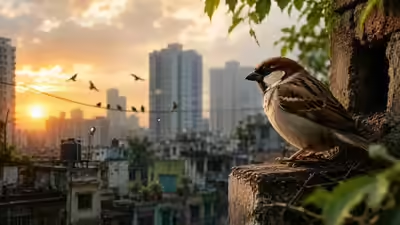
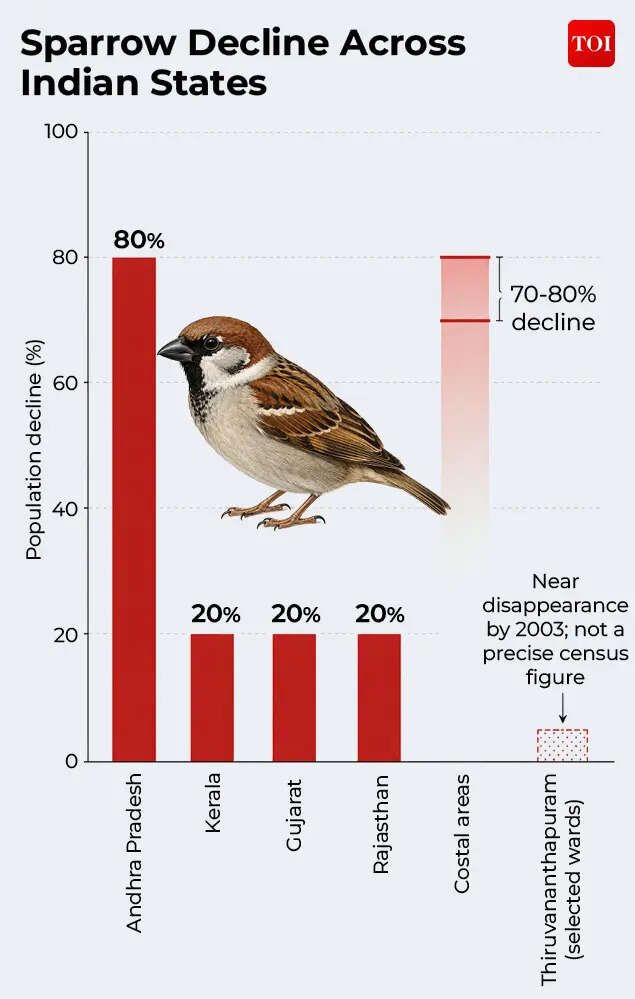
The first sight of the new dawn rolls in with almost evocative sceneries. The morning dew sits fresh on the leaves. The temperature offers a brief respite from the waves of oven-like heat to come and the sky is a thousand different shades of yellow and orange.But something is not quite right.The song of the birds is no longer the soundtrack of dawn. Honking cars have seemingly replaced them in most urban metropolitan cities. Now that it is gone its absence leaves a loud reminder. The chirps you did not know you were listening to, the ambient sounds that were always there, suddenly went quiet.The house sparrow has not disappeared. It has simply been pushed out. From our balconies, our memories, our cities. And the places it has gone tell a story we do not want to hear.The decline in sparrows is a global issue with BirdLife International reporting that the population has decreased by nearly 64% in Europe since the 1970s. The British Trust for Ornithology estimated that the sparrow population in London alone had declined by 71 per cent between 1994 and 2002. The decline is also observed in North America and parts of Asia, with the maximum decline occurring in urban and suburban areas.India is also no stranger to this disappearance, and the reason behind it is not really a mystery. The sparrow population in Andhra Pradesh alone dropped by 80 per cent. In Kerala, Gujarat and Rajasthan, it dipped by 20 per cent. The decline in coastal areas was as sharp as 70 to 80 per cent. In parts of Thiruvananthapuram, where volunteers had noticed small flocks of six to eight sparrows until 1998, they had disappeared without a trace by 2003. The reason behind this loss is not really a mystery.
The architecture of absence
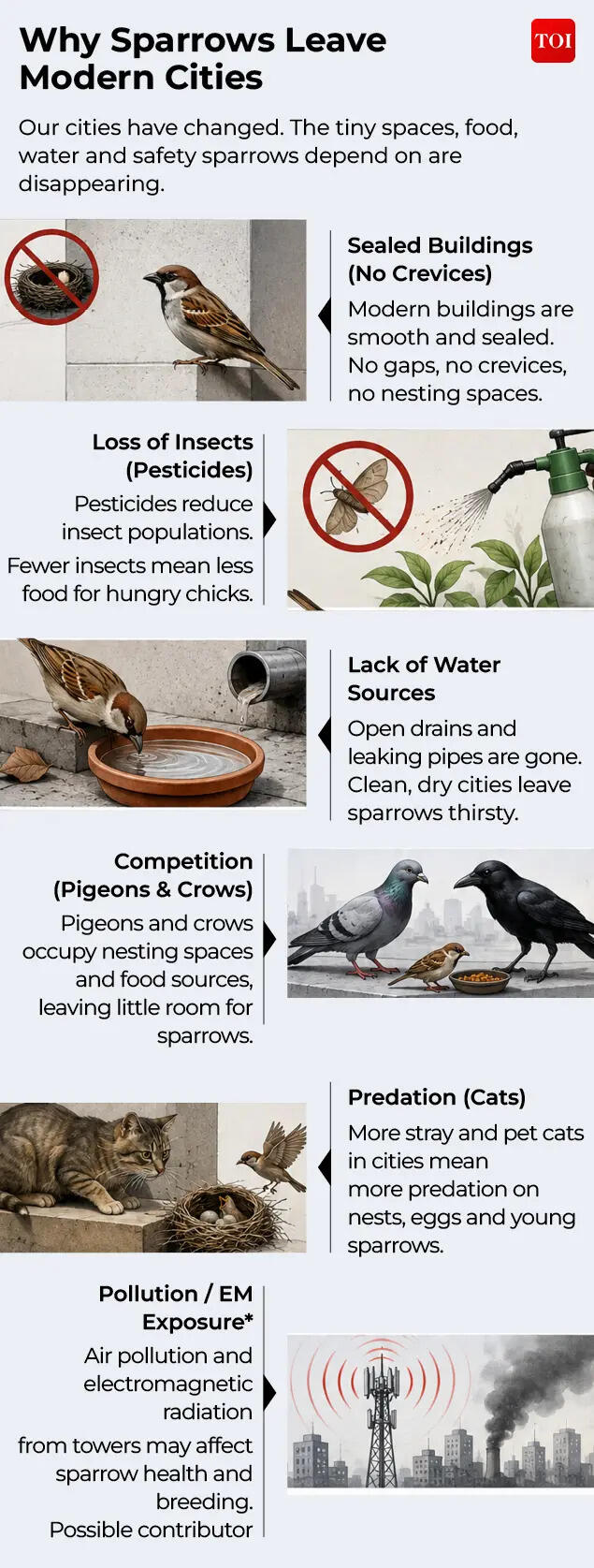
Walk through the narrow lanes of old cities, you might find nooks and crannies that the sparrow still feels comfortable calling its home. Hidden in the parts of the old city which still respect the sanctity of its presence.As the city transforms and skyscrapers pollute the sky lines of metropolitans, trees and parks are uprooted for crowded infrastructure, the sparrow also exits. It leaves behind a home it no longer recognises.Bird researcher Sujan Chatterjee puts it bluntly: “Modern architecture plays a decisive role here. Older homes, with their ventilators, tiled roofs, and small gaps, offered natural nesting spaces. Today’s glass-and-concrete structures are sealed, smooth, and inhospitable.”Old, spacious buildings are being replaced by matchbox flats. Hedges are being replaced by wrought iron fences. Gardens are paved, leaving no mud for sparrows to bathe in. The criss-crossing cable wires and the flow of electromagnetic waves from cellphone towers injure the sparrows, causing irritation and reducing their reproductive capacity.
How often do you notice the presence of house sparrows in your area?
The bird that once nested in every balcony, that woke generations of Indians with its insistent chirp, that was so common it was almost invisible — that bird is now a marker of class. Its presence or absence tells you more about a neighbourhood than any real estate brochure ever could.A sparrow needs three things: a place to nest, food to eat, and water to drink. It is a relatively sedentary bird, not travelling more than a kilometre or two in search of food. It prefers thatched houses and bungalows to concrete structures such as flats to build its nests.In old neighbourhoods, buildings provide nesting spaces naturally. In new neighbourhoods, buildings are sealed. Glass facades and smooth concrete, no eaves, no gaps and no crevices. Air conditioning units are installed in ways that block, rather than create, small spaces. Modern architecture is architecture that keeps birds out.
Why Sparrows Leave Modern Cities
The food question is equally telling. Sparrows feed on seeds, grains, and insects. On average, each sparrow eats about 1,000 caterpillars per year. As Chatterjee notes, “Increased pesticide use has reduced insect populations, which are critical for feeding sparrow chicks. Clean, sanitised cityscapes, while visually appealing, have removed the very resources that once sustained sparrows.” The reduction in the number of insects is a boon for your home but a bane for the sparrows.Even the water equation has changed. In old neighbourhoods, water is everywhere. Open drains, leaking pipes, uncovered buckets, birdbaths in courtyards. A sparrow never has to fly far to drink. In new neighbourhoods, drains are covered and pipes no longer leak as much. Water is contained, controlled, cleaned. This is good for hygiene but terrible for sparrows.
The hidden killers
The introduction of unleaded petrol may also be playing a role. Denis Summers-Smith’s theory suggests that unleaded fuel, believed to be eco-friendly, has harmful byproducts. The fuel uses Methyl Tertiary Butyl Ether (MTBE) as an anti-knocking agent. Along with byproducts of combustion, this kills small insects. Though adult sparrows can survive without insects in their diet, they need them to feed their young.Air pollution is another factor. Rising pollution levels in metropolitan cities indicate that the air is becoming dangerously toxic — for birds and humans alike. Since sparrows are mainly grain eaters, their decline could also mean that the grains we are consuming contain higher amounts of pesticides than before.Pigeons have become aggressive competitors. They occupy nesting spaces and often damage sparrow nests. Rising crow populations pose an additional threat. Unlike crows, which have adapted to thrive on human waste, sparrows cannot survive on garbage. They depend on specific ecological conditions: access to seeds, insects for their young, and safe nesting spaces. The world functions with the philosophy of survival of the fittest at every level.Invasive species such as starlings also compete with sparrows for food. These birds often have a more flexible diet, occupying urban niches more readily and outcompeting sparrows for habitats and resources.Increased predation by cats and competition for food by other species, including pigeons, crows and mynahs, has made survival even harder.The pattern is clear across India. In older, traditionally built, mixed-use neighbourhoods , where people live, work and trade in the same lanes, sparrows still survive. These are often the city’s poorer, more crowded, less “planned” areas. The ones that real estate developers are desperate to redevelop.In newer, wealthier, gated, sanitised neighbourhoods, where houses are set back from the road, where every building is sealed, where every open space is manicured, sparrows have vanished.
Why sparrows matter
Sparrows are not just nice neighbours. They play a crucial role in the ecosystem. They consume insects, which controls pests and reduces the need for pesticides. A new study has indicated that the loss of birds may contribute to the spread of diseases among humans. High bird diversity appears to protect humans from exposure to the West Nile Virus, which is transmitted by mosquitoes. Where there are more birds to bite, mosquitoes will bite proportionately fewer people, partly reducing their chances of picking up or spreading the infection.The spread of diseases due to decline in sparrow population is an alarming danger.In Hyderabad, a grassroots effort has begun to show what targeted intervention can achieve. The ‘Bring Back Sparrow’ campaign, launched in 2016 by the Animal Warriors Conservation Society, set out with a simple idea: if natural nesting spaces are disappearing, why not create them?Over the past decade, the organisation has installed more than 1,600 nest boxes across areas such as Ameenpur, Gachibowli, Dilsukh Nagar, and Alwal. In addition, over 1,000 nest boxes are distributed each year to households, institutions, and community groups. Nearly 20,000 sparrows have returned to these areas.
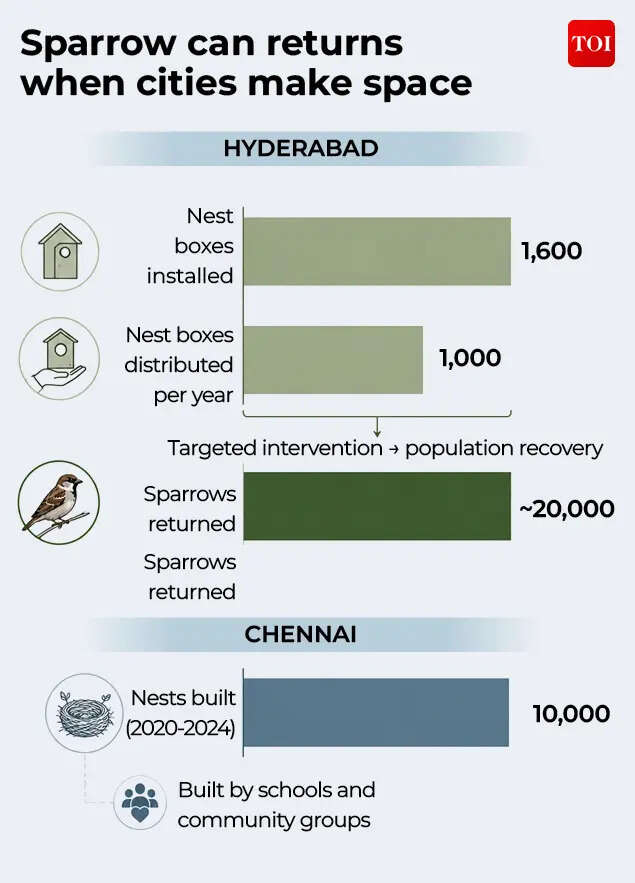
In Mumbai, Mohammed Dilaraw started the Box Initiative, putting up little wooden boxes on trees that sparrows could use as nests. He also kept little feeders with grains, insects and water to help the sparrows settle.In Chennai, the Koodugal Trust has involved school children in constructing nests for sparrows. Between 2020 and 2024, the trust constructed more than 10,000 nests. School children make small wooden houses that serve as shelter and provide food for sparrows. The effort has noticeably increased the number of sparrows in the area.In Mysuru, Karnataka, the ‘Early Bird’ initiative introduces children to birds through a library, activity kits, and excursions to villages to watch birds. These learning efforts are making children aware and knowledgeable about the role of sparrows and other birds in the ecosystem.Rajya Sabha member Brij Lal has installed 50 nests in his house. Every year, sparrows come to lay eggs in them. He takes care of them and provides them with food. His actions were appreciated by Prime Minister Narendra Modi, who highlighted the role of such individual efforts in conservation.
What needs to change
Chatterjee believes the answer lies less in grand interventions and more in restraint.“We often say sparrows have disappeared. But instead of asking why, we should ask what kind of spaces we are creating,” he explains.The solution, he suggests, is to allow nature to return. “Keep parts of your garden unmanicured. Let it grow. Leave some spaces undisturbed. Animals are not difficult to bring back, but you have to leave space for them.”“Beauty and habitat don’t always go hand in hand,” Chatterjee says. “If everything is trimmed, cleaned, and controlled, there’s nothing left for wildlife.”At a policy level, he suggests bird-friendly infrastructure. “It can begin with something as simple as rethinking our road boulevards, planting native bird-friendly shrubs, and reducing plastic use. Birds and butterflies need dense shrubs and undergrowth as hiding and nesting spaces. If we keep trimming, cleaning, and manicuring everything in the name of beautification, we risk erasing the very habitats they depend on.“You do not need a government scheme to save a sparrow. Leave out a bowl of water on your balcony, let a corner of your garden grow wild, plant something native instead of another exotic ornamental, put up a nest box where an air conditioner could have gone. Throw out some weed seeds now and then.The sparrow has not gone far. It is waiting for space.The dawn is still beautiful, the dew still settles, and the sky still burns orange and yellow. We cannot silence the honking, but we can make room for the chirping again.
