





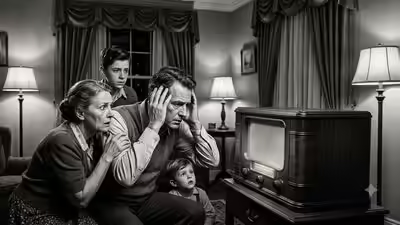

Late on an autumn evening in 1938, many Americans settled down beside their radios expecting an ordinary night of entertainment. Radio had become the country’s most trusted source of news and information. Families relied on it for election results, breaking events and speeches from political leaders. That sense of trust created an unusual moment in broadcasting history when a fictional drama briefly blurred the line between entertainment and reality. Listeners who tuned in at the wrong moment believed they were hearing urgent reports of an unfolding national emergency. The programme would later become one of the best-known examples of misinformation in modern media history, raising questions that still feel surprisingly familiar whenever false stories spread quickly through new forms of communication.
How the 1938 US radio broadcast blurred fiction and reality
As reported by the BBC, the programme was an adaptation of The War of the Worlds, H. G. Wells’ famous science fiction novel about an invasion from Mars. It aired on 30 October 1938 as part of the Mercury Theatre on the Air series, led by the young actor and director Orson Welles.Rather than presenting the story as a straightforward play, the production interrupted fictional music programmes with what sounded like urgent news updates. Reporters described mysterious explosions, strange objects falling to Earth and terrifying developments unfolding in Grovers Mill, New Jersey. The style closely resembled genuine radio bulletins, making the unfolding drama appear authentic to anyone who had missed the opening announcement explaining that the programme was fictional. That decision transformed an ordinary adaptation into something audiences had rarely experienced before.
Why so many listeners believed the broadcast
Radio occupied a different place in everyday life during the 1930s than it does now. It was widely regarded as an authoritative source of information. Live reports from political events, sporting fixtures and international crises had taught audiences to trust what came through their speakers.Many people did not begin listening at the start of the broadcast. Those who joined midway encountered voices that sounded like experienced journalists interrupting regular programming with urgent updates. The format borrowed familiar features of genuine reporting, including interviews, eyewitness accounts and official-sounding announcements.For some listeners, those details were convincing enough to create uncertainty. Some contacted police stations, newspapers or radio networks seeking confirmation of what they had heard. Others checked on neighbours or attempted to leave their homes, believing an emergency might be unfolding nearby.
Did it really create nationwide panic
As reported by the BBC, for decades, the broadcast has been remembered as the programme that sent millions of Americans fleeing from imaginary Martians. That version of events has become part of popular culture, although historians have questioned whether the reaction was ever as widespread as later accounts suggested.Contemporary newspaper reports described scenes of chaos and confusion, while Orson Welles later recalled stories of people driving away from their homes in fear. Yet evidence collected afterwards paints a more complicated picture.Many researchers believe the scale of the panic was probably exaggerated. Telephone calls from concerned listeners may have been interpreted as evidence of mass hysteria, while newspapers, already competing with radio for audiences, had their own reasons for highlighting the dangers of the newer medium.There is little firm evidence that millions of people genuinely believed the country was under attack. The reality appears to have involved a much smaller group of listeners who became temporarily confused before discovering the truth.
What Orson Welles later said about the broadcast
Years after the broadcast, Welles reflected on what had happened and suggested the production had unintentionally revealed how readily people trusted emerging forms of communication.He argued that audiences often accepted information delivered through a new technology without questioning it. In his view, the broadcast exposed that habit by encouraging listeners to think more carefully about what they heard instead of accepting every announcement at face value.Whether or not that had been the original intention, the programme became a lasting reminder that confidence in a communication platform can sometimes outweigh careful verification.
An early lesson in disinformation
The broadcast is frequently discussed alongside modern conversations about misinformation and disinformation, although the terms are not identical.Disinformation generally refers to false information that is knowingly created or shared with the intention of misleading others. Misinformation, by contrast, can spread without deliberate intent if people unknowingly pass on incorrect claims.Although The War of the Worlds was presented as entertainment rather than political propaganda, its realistic presentation demonstrated how believable false information could become when delivered in a trusted format.That lesson has remained relevant through successive generations of media, from television documentaries and internet rumours to social media posts that imitate legitimate news organisations.
The consequences for broadcasting
Public attention following the programme was immediate. Newspapers gave extensive coverage to the broadcast, while Orson Welles found himself answering questions about why the drama had been produced in such a realistic style.The controversy also influenced broadcasting standards. American radio regulators became increasingly cautious about fictional programmes that might be mistaken for genuine emergency reports. Future productions faced tighter expectations about making it clear to audiences when material was imaginary rather than factual.The incident became a reference point whenever broadcasters experimented with realism in fictional storytelling.
The forgotten inspiration behind the programme
Although the 1938 broadcast became famous, the idea itself was not entirely original.More than a decade earlier, British audiences had experienced something similar through a BBC broadcast written by Father Ronald Knox. His fictional account of civil unrest in London reportedly caused confusion because it sounded remarkably authentic.John Houseman, who produced The War of the Worlds, had known about that earlier programme from his time in Britain. According to later accounts, he ensured that listeners were informed before the American broadcast began that it was a dramatic performance.The difficulty was that many people missed the introduction after tuning in late, leaving them without the context needed to recognise the fictional format.
Similar controversies continued
The boundary between fiction and reality has continued to create problems long after 1938.In Britain, the BBC’s Ghostwatch in 1992 blended fictional storytelling with familiar television presentation, leading some viewers to believe they were watching genuine live coverage of paranormal events.The internet has produced even greater challenges. False claims surrounding major news stories, elections and public health have often spread rapidly through social media before independent fact-checking organisations or official sources could correct them. During the Covid-19 pandemic, for example, inaccurate stories about vaccines circulated widely online despite being disproved by scientific evidence.