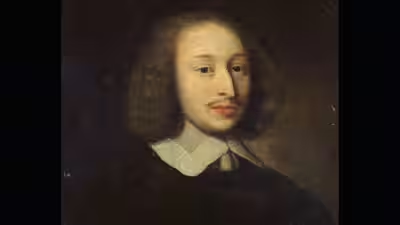

In 2014, psychologists at the University of Virginia placed participants alone in a plain room for 15 minutes. They had no phones, pens, or reading materials. The only object in the room was a small device that delivered a mild electric shock when a button was pressed. Before entering, every participant had said they would pay money to avoid being shocked. Yet, with no outside distractions, 67 per cent of the men and 25 per cent of the women chose to shock themselves instead of sitting quietly with their own thoughts. One participant pressed the button 190 times.The experiment provided scientific evidence for an observation made nearly four centuries earlier by French mathematician and philosopher Blaise Pascal. Writing in his notes, later published as Pensées, Pascal wrote: “All of humanity’s problems stem from man’s inability to sit quietly in a room alone.”Pascal was not making a simple joke about restlessness. He was pointing to a basic weakness in human psychology. People have a strong urge to seek distraction, no matter how meaningless or harmful that distraction may be, simply to escape the discomfort of self-reflection.
A brilliant mind retreating into silence
When Pascal wrote those words around 1660, he was living in self-imposed isolation at Port-Royal des Champs, a Jansenist abbey southwest of Paris.By his mid-twenties, Pascal had already become one of Europe’s greatest mathematical minds. He invented an early mechanical calculator, helped establish the foundations of probability theory alongside Pierre de Fermat, and carried out pioneering experiments on atmospheric pressure and vacuums.Despite these achievements, Pascal suffered from chronic physical pain and deep existential anxiety. On 23 November 1654, he experienced a powerful religious awakening, which he recorded on a piece of parchment that he kept sewn into the lining of his coat until his death. After this experience, he left pure mathematics behind to focus on philosophy and theology.Pascal began collecting notes for a major defence of the Christian religion. He never completed the work. When he died in 1662 at the age of 39, his relatives found hundreds of handwritten notes tied together with string. They were published after his death in 1670 as Pensées (Thoughts). Fragment 139 contained his famous explanation of human restlessness.Pascal observed the French nobility spending large amounts of money on hunting, gambling, and court intrigues. He realised these activities were not really about the prizes. A hunter did not actually need the hare he spent all day chasing. Instead, the chase distracted people from what Pascal called ennui, the cold and uncomfortable awareness of human mortality, weakness, and insignificance that appears when physical activity stops.
The psychology of diversion and divertissement
At the heart of Pascal’s philosophy is the idea of divertissement (diversion). He argued that people recognise their fragile existence, including their vulnerability to disease, loss, and death, and find that reality difficult to face. Instead of confronting it, they create endless forms of busyness.Pascal divided human life into two states: silence, where people face their inner reality, and diversion, where they create constant external distractions.This idea closely connects with Stoic philosophy, especially the writings of Marcus Aurelius, who encouraged people to find peace within themselves instead of seeking approval from others. However, while the Stoics believed reason could bring inner calm, Pascal argued that unguided self-reflection often leads to fear, pushing people back toward distraction.Centuries later, Søren Kierkegaard built on Pascal’s ideas, arguing that boredom is the root of much human wrongdoing because it drives people into rushed and unthinking actions. In the twentieth century, German philosopher Martin Heidegger described busyness as an escape from Dasein (being-there). He argued that constant activity prevents people from facing the reality of their own limited lives.
Constant connection in the modern age
Pascal developed his ideas in a world of quill pens and horse-drawn carriages, yet the pattern he identified has only become stronger.Today’s global economy profits from people’s discomfort with being alone. Digital platforms, endless media feeds, and constant phone notifications have become powerful forms of divertissement. A 2023 study by the Pew Research Center found that 31 per cent of American adults said they were online “almost constantly,” rising to 46 per cent among teenagers.The inability to tolerate stillness has real consequences for leadership, business, and everyday life. In financial markets, excessive trading often reduces investment returns. Research by Brad Barber and Terrance Odean at the University of California, Davis, examined 66,000 household trading accounts over five years and found that the most active traders earned the lowest net returns because they felt the need to act when remaining still would have produced better results.In political leadership, pressure to respond immediately to fast-moving news often leads to poorly considered policy decisions. Military strategist B.H. Liddell Hart argued in his historical studies that more battles were lost through rushed and unnecessary actions than through disciplined restraint.Modern psychological treatments now try to rebuild this lost ability. Mindfulness-Based Stress Reduction (MBSR), developed by Jon Kabat-Zinn at the University of Massachusetts Medical School in 1979, uses structured silence to help patients manage physical pain and anxiety without relying on constant avoidance.Pascal did not argue that people should withdraw completely from society. Instead, he believed that until someone can remain alone with their own thoughts without escaping into trivial distractions, their choices will continue to be driven by fear rather than conscious decisions.In one of his final notes in Pensées, Pascal wrote: “The eternal silence of these infinite spaces terrifies me.” The fear was genuine, but Pascal believed that remaining in that silence is the only way to truly understand ourselves.