


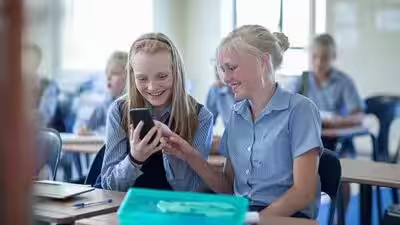

There was a time students carried lunch bags and bottles in their hands. Now those things have been replaced with larger-than-life smartphones and iPads that contain all the information and their attention. This has prompted at least 35 states along with the District of Columbia to ban smartphones in some capacity. There are 24 states that have a straight bell-to-bell restriction on smartphones in schools. That is, they are not allowed at all from the time school starts to the time school ends. Some of these states include Alabama, California, Texas, and New York. For Florida, Georgia, and Hawaii, the bell-to-bell ban is only effective for grades K-8. There are 10 other states that only ban smartphones when it’s instructional time in the classroom, including Indiana, Utah, and Nevada.When students in Kansas return to school later this month, a new law will require that their personal cellular communication devices, including phones, earbuds, and smartwatches are not accessed during the school day. While some parents and kids consider phones a safety precaution, parent support for the bans is growing. Students in the Shawnee Mission School District will be required to leave their cellular devices at home, in their vehicle or store them in a school-issued locker, according to district Superintendent Dr. Michael Schumacher.Megan Coffey, a parent of children in the Shawnee Mission School District and member of the advocacy group Schools Beyond Screens, is in favour of the new law, according to a report by NPR. “I support it because there is so much data and research that also supports it,” Coffey said.Some educators have reported students are distracted by phones during instruction time. But phones also hurt the mental and developmental health of users.

There is also a growing concern over how technology is being used in the classroom, what is accessible and the amount of screen time kids are exposed to.
But phones are not the only thing distracting students and affecting their mental health. There is also a growing concern over how technology is being used in the classroom, what is accessible and the amount of screen time kids are exposed to. Gretchen Shanahan, a Shawnee Mission parent and Schools Beyond Screens advocate, wasn’t happy to learn her elementary-age children were consistently given iPads during indoor recess. “I was upset because I had not wanted my kids to have these devices, even in our own home, because I knew that it wasn’t developmentally appropriate,” Shanahan said. Through a news app pre-installed on the school-issued device, Shanahan said her children had access to stories about Jeffrey Epstein and other content that she felt was inappropriate for kids their age. “We need to know what it is that we’re wanting to teach them because giving a student an iPad does not mean that they’re learning anything about technology,” Shanahan said.Now, both parents want more oversight and regulation on the use of digital media in school. School Beyond Screens is advocating for districts to stop kindergarten through second grade students from being issued personal devices, restrict YouTube, and pause implementing artificial intelligence policies, among other reforms.Schumacher said he recognises the growing number of parents with these concerns, and the district is making changes. “One of the things I’ll admit I think we lost track of was, you know, those devices going home and parents not wanting those devices to go home,” Schumacher said.Now, elementary-aged students in the Shawnee Mission School District will also no longer take school-issued iPads home unless for a specific assignment, and iPads cannot be used indoors during recess or reward time. “We want to make sure that they are being used absolutely for instruction and not for any passive use,” Schumacher said.Moreover, the district is developing policies around instructional technology and artificial intelligence. “There’s going to be an opportunity for the community to participate with us on some of that board policy development,” the superintendent said.
