


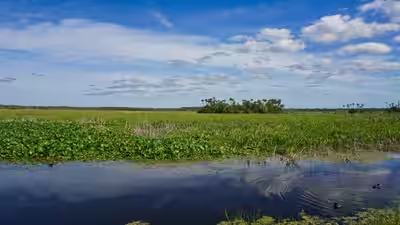
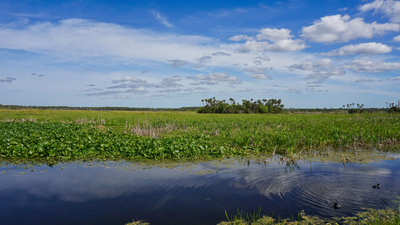
In 1987, Orlando put 1,200 acres of constructed wetlands to work cleaning reclaimed water. Today, the system treats about 5.11 billion gallons of water each year.However, keeping this large natural filtration system working efficiently requires regular land management. As aquatic plants grow, absorb extra nitrogen and phosphorus, and eventually die and decay, a thick layer of organic muck slowly builds up on the bottom of the marsh. When this sediment becomes too thick, it can slow water flow and cause stored nutrients to return to the water. This makes periodic earthmoving work necessary to keep the system working properly.According to operational records published by the City of Orlando Water Reclamation Division, city crews carry out large renovation projects, known as demucking, to remove the built-up organic material and restore the marsh’s original ability to clean the water.
Clearing 200,000 cubic yards of organic sediment
Ongoing research and water-flow monitoring help the city determine when specific areas of the 1,200-acre complex need maintenance. Once an area is chosen, operators separate it from the rest of the system, close the incoming water lines and completely drain the marsh cell.Heavy construction equipment then moves onto the dry basin floor. Workers scrape away dead vegetation and about 18 inches of compacted organic muck. City records show that individual renovation projects cover about 100 acres on average and remove around 200,000 cubic yards of organic sediment during each cycle.After the heavy equipment finishes, workers level the ground and replant native aquatic plants. These species are selected because they can absorb nutrients effectively and provide good habitat for wildlife. Important plants used during restoration include giant bulrush, pickerelweed and duck potato.Once the area has been replanted, water gates are opened again. Reclaimed water from Orlando’s municipal treatment facilities can then flow through the restored marsh cells. The city first used this demucking method in August 2002, after about 15 years of continuous operation. Similar renovation projects have since been carried out in different parts of the property to keep the wetland’s water-cleaning performance stable.
How aquatic plants remove nutrients from municipal effluent
The main biological process depends on a continuous natural cycle that cleans reclaimed water before it leaves the facility. When treated water enters the 1,200-acre wetland, aquatic plants remove extra nitrogen and phosphorus from the water through their growth.As the plants grow, they take in these dissolved nutrients and store them in their tissues. But this natural growth also creates the main long-term maintenance problem that makes demucking necessary.When the plants finish their life cycle, they fall into the shallow water and slowly decay. Their remains collect on the bottom and form a thick layer of organic muck. Over many years, this layer becomes deeper and denser.If the sediment is not removed, it can slow the movement of water through the marsh. Nutrients trapped in the organic material can also be released back into the water. At this point, mechanical removal is needed to restore the wetland’s ability to filter the water effectively.
Historical wet prairie roots of the St. Johns River basin
The land where the Orlando Wetlands is located was historically a wet prairie, a type of freshwater wetland that played an important role in the hydrology of central Florida. Records from the St. Johns River Water Management District describe wet prairies as mostly treeless freshwater wetlands dominated by native grasses, sedges and other plants adapted to soils that remain wet for long periods.The original land was part of the upper St. Johns River basin, a large marshy headwaters region. This basin developed naturally because the St. Johns River has an extremely low slope, dropping only about one inch per mile.Because the land is so flat, water moves very slowly across it. This creates wide, shallow wetlands that can remain wet for much of the year. The original wet prairie was ecologically important because it stored floodwater, filtered nutrients coming from surrounding watersheds and provided habitat for many species of birds, fish and amphibians.By converting former agricultural land back into a functioning artificial marsh in 1987, the City of Orlando restored some of these natural water-management functions while also creating a reliable, low-energy municipal water treatment system.
Long-term maintenance keeps water polishing effective
Without regular physical maintenance, constructed wetlands can gradually lose their ability to treat municipal wastewater. The demucking program helps prevent the 1,200-acre artificial marsh from becoming clogged with sediment or becoming a source of nutrient pollution.By regularly draining sections of about 100 acres, removing around 18 inches of decayed organic material, leveling the soil and replanting native species such as giant bulrush and pickerelweed, the city maintains the wetland’s ability to move and clean water.The process combines engineering with natural biological processes. This allows the artificial wet prairie to continue polishing about 5.11 billion gallons of reclaimed water each year while also maintaining a stable habitat for local wildlife.
