


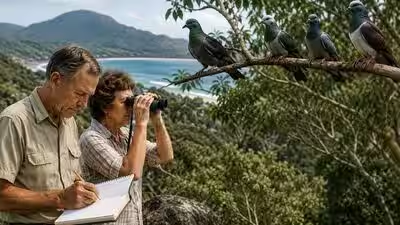
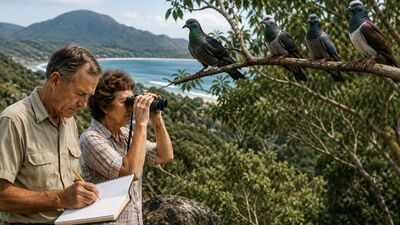
A couple, Margaret and Arthur Thorsborne, travelled north from Queensland’s Gold Coast to Hinchinbrook Island, a place they knew largely through photographs. They would return many times, eventually making the Cardwell area their home and becoming closely associated with its forests, wetlands and wildlife. Among the animals that caught their attention were pied imperial-pigeons, which gathered on North Brook Island to breed but faced a very different future from the one their numbers might suggest today. The couple’s response was practical: watch the birds, record their numbers and challenge the shooting and habitat loss that were pushing the colony towards collapse.
North Brook Island’s pigeon count revealed a population in decline in 1965
North Brook Island sits off the coast near Cardwell, within the small Brook Islands group east of Hinchinbrook Island. For part of the year, it becomes a breeding ground for pied imperial-pigeons, also known as Torresian imperial-pigeons. The birds travel between their island nesting grounds and the mainland, where they feed on rainforest fruits before returning to the colony.When the Thorsbornes first encountered the birds, they were not simply looking at an impressive concentration of white plumage. They were seeing a population under pressure.The pigeons had been protected by law for decades, but that did not prevent people from shooting them. Birds returning to their breeding colonies were particularly vulnerable, and the scale of the killing could be substantial. The problem was made worse by the loss and clearing of coastal forest that supplied the pigeons with food.According to the study published in Emu – Austral Ornithology, titled ‘Population trends over 50 years of a Pied Imperial-Pigeon breeding colony on North Brook Island, a tropical Great Barrier Reef island, Australia’ revealed when the Thorsbornes began counting the colony in 1965, turning their concern into a record that could be followed from year to year. The first count recorded 4,692 birds during the 1965–66 breeding season. Within only a few years, however, the number had fallen sharply.Then by 1968, the December count had reached just 1,451 birds as reported. That number became an important point in the history of the colony. It showed that the decline was not simply something people thought they were seeing in the forest. There was a measurable change.
North Brook Island’s annual count grew into a conservation campaign
The annual survey was never just about producing a number. The Thorsbornes used what they were seeing to draw attention to the shooting of the pigeons and to the condition of the forests on which the colony depended. Historical accounts describe large-scale shooting in this period, including incidents in which hundreds of birds could be killed. The pressure eventually eased, with large-scale shooting stopping in 1968.The Thorsbornes were not working alone. Friends, volunteers and conservation organisations became involved, and the project gradually moved beyond the couple’s own efforts. By the 1980s, Queensland Parks and Wildlife Service had taken responsibility for organising and funding the counts, with ranger Dave Green playing an important role. The survey expanded to multiple counts during some breeding seasons.What began with Margaret and Arthur on North Brook Island had become a long-running community exercise.
How a colony of just 1,451 birds grew into the tens of thousands
As reported by the Australian Geographic, the counts traced a much longer change. From the low point of 1,451 birds after the sharp decline of the late 1960s, numbers began to rise once the large shooting parties stopped. By the colony’s 21st birthday, the evening return flight had reached 20,000 birds. Numbers continued to climb, later fluctuating between roughly 25,000 and 35,000 until 2011, when Cyclone Yasi caused another dramatic fall in the count.The significance of the change is easier to see when the figures are placed beside one another. In 1968, there were 1,451 birds in the December count. Decades later, the colony had reached tens of thousands.That did not mean the original threats had disappeared. Nor did the recovery belong to the Thorsbornes alone. The end of large-scale shooting, continued monitoring, protection of feeding habitat and the involvement of government agencies and volunteers all formed part of the story.
The cyclone that changed the numbers again in 2011
In February 2011, Cyclone Yasi crossed the Queensland coast and caused extensive damage across the region.For the pied imperial-pigeons, the storm was more than an isolated weather event. Their breeding island habitat was affected, while forests on the mainland that supplied food were also damaged. As reported by the Wildlife Preservation Society of Qld, the colony had been averaging around 34,000 birds before the cyclone, according to the long-running monitoring record.The decline that followed complicated what had previously looked like a straightforward recovery story.The birds did begin to return. But the colony did not simply climb back to its earlier level. Recent accounts of the monitoring project describe numbers settling at around 23,000 after the post-Yasi recovery, well below the average recorded before the cyclone. The reasons for the plateau are still being examined.This is one reason the old counts remain useful. They are not just a record of a conservation success. They provide a baseline against which later changes can be understood.Without the earlier observations, it would be much harder to know how dramatically the colony had changed.
The people who kept the pigeon count going for decades
Margaret Thorsborne remained closely involved with the pigeon project for much of her life. Arthur died in 1991, the same year that the Thorsborne Trust was established in his memory.Margaret continued her conservation work until her death in 2018. She served as the Trust’s principal trustee from its foundation and was recognised with an Officer of the Order of Australia in 2011. Her work extended well beyond the pigeons, covering the protection of Hinchinbrook’s landscapes, cassowaries, mahogany gliders, native plants and other wildlife.Dr John Winter, who became closely involved in the survey from the 1970s, has continued working on the population record and the effects of Cyclone Yasi. Local residents, conservation volunteers, Girringun Rangers, council representatives and people associated with research organisations have also contributed to the counts over the years.There have been practical obstacles. At one point, Queensland Parks and Wildlife Service could no longer provide a boat for every count. The Thorsborne Trust, with assistance from the Wettenhall Environment Trust, paid for commercial boat hire for five years so that the monitoring could continue without breaking the sequence of observations.It is an easily overlooked part of conservation work. Sometimes protecting a population means making sure someone can still get to the place where it is being counted.
Margaret and Arthur’s work spread beyond one colony
The pigeons were only one part of the Thorsbornes’ conservation efforts around Hinchinbrook and Cardwell.After moving permanently to the Meunga Creek area in 1972, the couple became involved in campaigns to protect the wider coastal environment. Their own property, Galmara, included wetlands and rainforest facing Hinchinbrook Island. In 1980, 23 hectares of their land was donated to the Queensland National Parks and Wildlife Service to extend Edmund Kennedy National Park.Margaret was also involved in habitat restoration and work associated with cassowaries, including the collection and propagation of food plants. The Thorsborne Trust later supported projects concerned with the southern cassowary, mahogany glider and other native species.There was a practical quality to much of this work. Trees were planted. Seeds were collected. Habitat was restored. Wildlife was monitored. Land was defended from development. The Trust’s later activities followed the same broad approach.
A conservation trust carried the work forward
The Thorsborne Trust was launched in 1991 to commemorate Arthur Thorsborne and provide a means of continuing the conservation principles shared by Arthur and Margaret.Its work has included habitat protection, wildlife conservation, environmental education, research and community projects. One example involved land beside the Hinchinbrook Channel that was under threat of being leased for private development in the late 1990s.The Trust lodged its own application to lease the land, stating that it would be used for conservation and that the application could be withdrawn if the Queensland Government guaranteed the land’s protection. The Trust was not successful in obtaining the lease. The intervention nevertheless helped keep attention on the conservation value of the area, which was later incorporated into Girramay National Park.The same approach appears in the pigeon project: conservation does not necessarily begin with ownership or control of land. Sometimes it starts with keeping records, raising a concern and making sure the issue stays visible.
The colony is still being watched
The North Brook Island count has now become one of Australia’s longest-running wildlife monitoring programmes. In 2025, the survey reached its 60th season.That longevity gives the project an unusual value. Wildlife populations can fluctuate from one year to the next, and a short survey may mistake a temporary change for a lasting trend. Six decades of observations provide a much wider view.The pigeons themselves remain tied to conditions beyond the island. They need suitable breeding habitat, but they also depend on mainland forests for food. Damage to either part of that system can affect the colony.
