


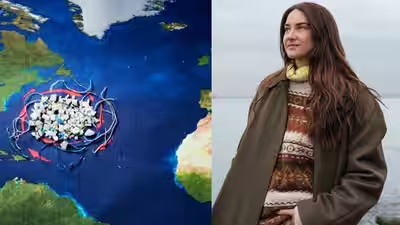
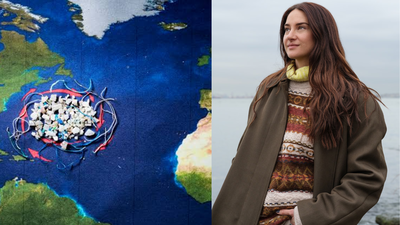
Far from the beaches and busy coastlines where plastic pollution is easiest to see, scientists found evidence of a much less visible problem in the Sargasso Sea. During a 2019 Greenpeace expedition, actress Shailene Woodley joined researchers collecting samples from the remote North Atlantic ecosystem, where floating Sargassum provides habitat for marine life. As reported by Greenpeace, one sample contained 1,298 microplastic fragments, highlighting how tiny pieces of plastic can accumulate even in distant ocean waters. The findings placed the Sargasso Sea within a wider debate about marine pollution, while Woodley’s involvement connected the scientific expedition with a campaign for stronger protection of international waters.
The Sargasso Sea became the focus of a scientific expedition
Woodley joined Greenpeace on an expedition to the Sargasso Sea in 2019, travelling with scientists who were collecting samples for microplastic research. The location mattered because the Sargasso Sea is a remote open-ocean ecosystem rather than a heavily developed coastal environment.The Sargasso Sea is an area of the North Atlantic defined by ocean currents rather than a physical shoreline. Those currents help concentrate floating material in particular parts of the ocean. Plastic that has broken down into progressively smaller pieces can remain in the water column and move with these circulation patterns, allowing researchers to examine pollution far from the places where much of the original material was used and discarded.That made the expedition useful for a broader question. If plastic fragments could be detected in such an isolated marine environment, the problem could not be understood simply as a matter of litter washing up on a beach.

PC: National Geographic
The plastic pollution hidden beneath apparently clean water
The material being collected was not the sort of plastic waste that can be picked up by hand. Microplastics are generally tiny fragments or particles produced when larger plastic items break apart, although some are manufactured at small sizes. Their scale changes the way pollution behaves in the sea. Larger objects can sometimes be tracked, removed or photographed. Much smaller fragments can become dispersed through seawater and interact with marine organisms in ways that are considerably harder to see.The Sargasso Sea therefore offered researchers a place to examine a form of pollution that can be present without creating an obvious visual sign. A stretch of blue water can appear clean while containing thousands of minute plastic particles.That contrast is part of what made the expedition scientifically useful. The absence of visible rubbish did not necessarily mean the absence of plastic.
One Sargasso Sea sample contained 1,298 microplastic fragments
During the Greenpeace expedition, scientists recorded high concentrations of microplastic in the North Atlantic. One sample contained 1,298 microplastic fragments, a figure reported as exceeding levels found in the Great Pacific Garbage Patch.The comparison is striking because the Sargasso Sea is not normally associated with the enormous accumulation of floating debris that has made the Pacific region famous. Yet the sampling showed that significant concentrations of tiny plastic particles could exist in another remote ocean system.A single sample cannot describe every part of the Atlantic, and concentrations can vary considerably depending on currents, location, depth and sampling conditions. What the expedition provided was a snapshot of pollution within an ecosystem that is otherwise difficult to observe from land.
A remote ecosystem is also a nursery for marine life
The Sargasso Sea has another reason for attracting scientific attention. Its floating mats of Sargassum provide habitat in the open ocean, where shelter can be limited.The ecosystem is associated with juvenile sea turtles and other marine organisms that use the floating vegetation as habitat and feeding grounds. The relationship between plastic pollution and these organisms is therefore an important part of the wider research question.Microplastics do not remain neatly separated from marine ecosystems. Small particles can be encountered by organisms at different levels of the food web. Understanding exactly what happens after exposure is complex and depends on the species, the type of plastic, the concentration and other environmental conditions.For scientists working in the Sargasso Sea, the issue is consequently larger than measuring plastic alone. The samples provide evidence about what is present in the water within a living ocean environment.
The Sargasso Sea expedition became part of a bigger campaign
Woodley’s involvement brought a recognisable public figure into a scientific campaign, but she had concerns about celebrity environmentalism before agreeing to take part.She wanted to know what Greenpeace intended to do with the expedition and how the information gathered at sea would feed into wider action. Her position, as described by National Geographic, was that taking part only made sense if the work extended beyond a photograph or a social media post.That approach became part of her longer involvement with Greenpeace’s campaign for stronger protection of international waters. The Sargasso Sea expedition was connected to the organisation’s work around the High Seas Treaty, an agreement intended to create a legal framework for conserving marine areas outside national jurisdiction.Woodley later took part in advocacy aimed at policymakers and United Nations officials, rather than treating the expedition as a standalone environmental appearance.
The pollution story reaches far beyond the Sargasso Sea
The significance of the expedition lies partly in what it says about the geography of plastic pollution. Plastic entering the ocean does not necessarily remain close to the source. Currents can transport floating material over considerable distances, while sunlight, waves and physical abrasion can gradually break larger objects into smaller fragments.That creates a difficult research problem. By the time a scientist finds a microplastic particle in an offshore sample, its original source may be impossible to identify. The Sargasso Sea offers an unusually clear example of this problem. It is geographically remote, yet it is connected to the wider Atlantic circulation system. The plastic found there is part of a much larger movement of material through the ocean.
A laboratory without walls
Calling the Sargasso Sea a pollution laboratory does not mean it is an artificial testing site. It is the opposite. The value comes from studying pollution under real ocean conditions, within an ecosystem shaped by currents, floating vegetation and marine life.Scientists can collect water samples, count particles and identify the types of plastic present. Those measurements can then be considered alongside information about the area’s currents and biology.The work also illustrates why microplastic research often begins with something as simple as a water sample. Much of the problem cannot be understood from photographs of beaches or large pieces of floating rubbish. The smaller material requires sampling and laboratory analysis. In the Sargasso Sea, the ocean itself becomes the study environment.
Woodley’s ocean work continued after the expedition
The 2019 expedition was one part of a wider period of environmental campaigning for Woodley. Her involvement with ocean issues later included public advocacy for the High Seas Treaty and appearances connected with marine conservation.As reported by Sustainable Fisheries UW, she also appeared in the 2024 PBS documentary series Hope in the Water, in an episode examining overfishing and alternatives to conventional seafood. The programme looked at ways seafood production and consumption could place different pressures on marine ecosystems.Her environmental work has not been limited to the ocean. Before turning more heavily towards marine conservation, Woodley became involved in grassroots organising around the Dakota Access Pipeline protests in 2016. She had also worked on voter canvassing in rural California, experiences that introduced her to organisers working outside the entertainment industry.The Sargasso Sea expedition sits within that longer pattern. The setting was remote, the pollution was largely invisible, and the scientific work depended on gathering evidence rather than simply documenting what could be seen from shore.
Why the Sargasso Sea matters to microplastic research
The expedition offered a useful reminder that marine plastic pollution is not confined to crowded coastlines or recognisable garbage patches. Tiny fragments can occur in remote parts of the Atlantic, including waters that support distinctive ecosystems.For scientists, the Sargasso Sea provides a place to examine that problem within the ocean itself. The samples collected there help reveal what is present beneath an apparently clean surface, while the surrounding biology raises questions about how persistent plastic particles interact with marine life. That is what turned the remote Atlantic region into a pollution laboratory. The sea did not need to be covered in visible rubbish for researchers to find evidence of human waste. The particles were already dispersed through the water, small enough to be missed by the naked eye but measurable when scientists went looking for them.
