


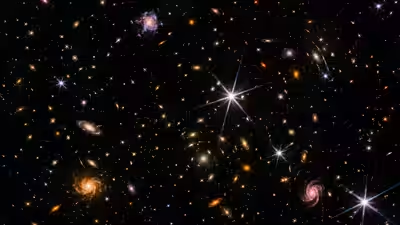
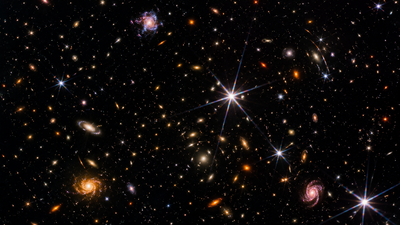
For billions of years, the universe has hidden its strangest secrets in faint, ancient light. Now, the James Webb Space Telescope may have caught one of them: an object from the universe’s infancy that looks like a giant red star, shines with the power of something vastly more luminous than an ordinary star, and may actually be a black hole wearing a cloak of hydrogen.The object, named MoM-BH-1*, could be a previously unknown type of cosmic source, a “black hole star.” Scientists believe a black hole roughly 100,000 times the mass of the Sun may be buried inside an enormous envelope of dense hydrogen, creating an object roughly the size of our solar system and an astonishing 100 billion times brighter than an ordinary star.At the centre of this discovery is Rohan Naidu, a Hyderabad-born astronomer and lead author of the study published in Nature. His own journey to this extraordinary finding is almost as unexpected as the object itself: at 18, he left engineering school, discovered astronomy in Singapore, and eventually found himself investigating some of the earliest galaxies and black holes in the universe from MIT.
A source that did not behave like an ordinary galaxy
MoM-BH*-1 was identified through the Mirage or Miracle (MoM) survey, which searches for some of the earliest and most distant galaxies in the universe.While studying JWST observations, researchers noticed a source that was exceptionally bright and unusually red. At first glance, it could have been mistaken for a distant galaxy. But its light contained several unusual characteristics.Its extraordinary brightness was difficult to reconcile with an ordinary population of stars. Its colour was also striking, while its spectrum revealed features that pointed towards an extremely dense environment.The object is estimated to be roughly the size of our solar system but about 100 billion times brighter than an ordinary star. Such an enormous energy output forced the researchers to look beyond conventional stellar explanations.That investigation eventually led them to a remarkable possibility: a black hole surrounded by a huge envelope of gas.
What exactly is a ‘black hole star ’?
The term describes a proposed configuration rather than a conventional star.Researchers believe MoM-BH*-1 could contain a central black hole around 100,000 times the mass of the Sun. Surrounding it could be an enormous envelope of dense hydrogen extending to approximately the scale of our solar system.The black hole would provide the energy. The hydrogen envelope would determine how that energy appears from a distance.As matter falls towards an actively feeding black hole, gravitational energy can be converted into vast amounts of radiation. The resulting energy release can be far greater than what ordinary stars generate through nuclear fusion.In MoM-BH*-1, scientists believe the dense hydrogen could surround the black hole so completely that the entire structure takes on a star-like appearance.That is why researchers have described the object as a possible black hole star, a black-hole-powered source hidden beneath a massive, stellar-like layer of gas.
Its extreme brightness holds the biggest clue
The sheer luminosity of MoM-BH*-1 is one of the strongest reasons scientists believe something unusual is happening.Normal stars, including the Sun, are powered by nuclear fusion. But the researchers estimate that this source is approximately 100 billion times brighter than an ordinary star.That level of brightness is difficult to explain through conventional stellar fusion.A rapidly feeding black hole, however, offers a powerful alternative. As matter is drawn into the black hole, it can become extremely hot and release enormous quantities of energy.In this scenario, the black hole acts as the engine while the surrounding hydrogen effectively hides the engine from view.The result could be an object that looks like a gigantic star but is actually powered by a black hole.
A mysterious spectral break provided another clue
The researchers found another important clue when they studied the object’s spectrum.MoM-BH*-1 showed an unusually deep Balmer break, a spectral feature associated with hydrogen absorbing particular wavelengths of light. According to the researchers, the break was exceptionally strong and made it difficult to explain the object as a collection of ordinary stars.Its chemical composition was also unusual.The observations showed little clear evidence of heavier elements, with hydrogen and helium dominating the available signatures. That is particularly significant because the object comes from the early universe, before repeated generations of stars had enriched cosmic gas with large quantities of heavier elements.The combination of extreme brightness, unusual redness, a deep Balmer break, and a scarcity of heavier elements made MoM-BH*-1 unlike typical stars or galaxies.
Could dense hydrogen make it look red?
The researchers then turned to simulations to understand whether a dense hydrogen envelope could reproduce what JWST had observed.One possibility was that dust was responsible for the object’s red appearance. But the team explored whether hydrogen alone could produce the effect.The simulations suggested that extremely dense hydrogen could act almost like the surface of an enormous star. Instead of behaving like a thin cloud of interstellar gas, it could become so dense that it forms an opaque outer layer.When the researchers introduced an accreting black hole into the model, the resulting object closely matched several of the properties observed by JWST.The model therefore provides a compelling explanation for MoM-BH*-1, although further observations will be required before scientists can establish whether black hole stars are genuinely a new class of astrophysical objects.
The discovery may explain JWST’s ‘little red dots’
The importance of MoM-BH*-1 extends beyond one unusual source.Since JWST began observing the early universe, astronomers have found numerous compact objects that appear unusually red. These have become known as “little red dots”, and their true nature remains one of the telescope’s most debated discoveries.One possibility is that at least some of these objects are powered by rapidly growing black holes surrounded by dense gas.The black hole star model could help explain why the little red dots are so bright and why they appear to have such distinctive colours and spectra.MoM-BH*-1 is particularly useful because it appears to be bright enough to overwhelm the light from its surrounding host galaxy. Researchers can therefore study the black-hole-star-like component without having to separate it completely from the glow of a much fainter galaxy.If similar objects are eventually identified, they could help astronomers understand what was happening inside young galaxies during the universe’s formative years.
From Hyderabad to the edge of cosmic history
Naidu’s path to this discovery is almost as unusual as the object itself.According to his MIT biography, he grew up in Hyderabad and initially studied engineering. At the age of 18, however, he dropped out.What followed was a dramatic change in direction. Naidu travelled to Singapore after buying his first-ever plane ticket and joined the founding class of Yale-NUS College. It was there that his interest in astronomy began to develop.He subsequently worked on blazars in the Chilean Andes with Professor Charles Bailyn and gained further research experience with astronomers including Iva Momcheva and Pascal Oesch.Naidu later pursued a PhD at Harvard under Professor Charlie Conroy. His doctoral research focused on the ancient history of the Milky Way, using the H3 Survey to study some of the oldest stellar systems and galaxies that had been absorbed into our galaxy over cosmic history.His work gradually shifted towards the early universe, particularly the first galaxies and the earliest black holes that formed after the Big Bang.Today, his research broadly examines when the first galaxies emerged, how they contributed to the reionization of hydrogen, and how the early universe produced the elements that eventually became the building blocks of planets and life.
A possible missing link in the story of the early universe
MoM-BH*-1 is still a candidate, not a final answer. Scientists will need further observations to determine whether the black hole star interpretation stands up to scrutiny.But the possibility is significant.If these objects existed in large numbers, they could help explain the mysterious little red dots, reveal how black holes grew rapidly in the young universe, and potentially shed light on how the enormous black holes found at the centres of galaxies came into existence.For Naidu, the discovery marks another step in a career devoted to understanding the universe’s earliest structures.The journey that began with an 18-year-old leaving engineering in Hyderabad has now reached almost the beginning of cosmic history. And in the faint, ancient light captured by JWST, astronomers may have found evidence of something that looks like a star, shines with unimaginable power, but could actually be a black hole hidden beneath a colossal cloak of hydrogen.
