







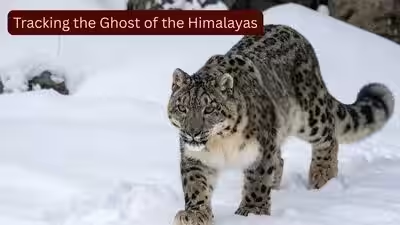

Spotting a snow leopard is mostly connected with a human’s luck. In your lifetime, if you have spotted one, it is proof that luck is on your side. Because in the wild language, it is the equivalent of finding a living myth! So now you can understand the rarity. Also known as the “Ghost of the Mountains,” the elusive big cat has perfected the art of hiding/disappearing into the snow-covered landscapes of the mighty Himalayas. It is often counted among the most rare travel experiences in the world. According to a report by EcoPortal, scientists have successfully fitted GPS satellite collars on four snow leopards in the Himalayas to understand the secrets of one of the world’s most elusive big cats. It is a huge step which can tell the world a lot about these elusive cats. All thanks to modern technology helping humans to understand the secret life of this mysterious predator. Now, researchers are tracking their movements across one of the world’s harshest mountain landscapes. While the initiative is primarily aimed at conservation, it could also reshape the future of wildlife tourism and Himalayan travel.Why does tracking snow leopards matter

Snow leopard
Snow leopards are special for several reasons. They live between 3,000 and over 5,500 metres above sea level, amid rugged cliffs, glaciers and alpine valleys across 12 countries including India, Nepal, Bhutan, China and Mongolia. These creatures are extremely mysterious and so inaccessible that scientists still don’t know much about how they move, hunt or multiply.GPS collars to the rescue Now here comes the GPS collars to the rescue. These are helping scientists to transmit exact location data, helping them understand migration routes, preferred habitats and seasonal movements. This information allows researchers to identify critical wildlife corridors, minimise human-wildlife conflict and better protect habitats before they disappear completely.The Himalayas hold many secrets

The Himalayas
Let’s agree that the Himalayas are among the least explored wildlife frontiers on Earth. Thick snow, freezing temperatures, and thin air make scientific research extremely difficult.That is precisely why satellite telemetry has become invaluable. Researchers no longer need to rely solely on camera traps or footprints in the snow. GPS collars are helping individual cats navigate enormous territories, sometimes even crossing international borders between Nepal, India and China. Before this, studies showed that snow leopards occupy territories far larger than scientists once thought.India’s role in snow leopard conservation

Hemis National Park (Canva)
In 2024, the country’s first nationwide scientific assessment estimated that 718 snow leopards inhabit the Indian Himalayas across Ladakh, Jammu & Kashmir, Himachal Pradesh, Uttarakhand, Sikkim and Arunachal Pradesh. It was one of the first reliable reports for monitoring one of the world’s most elusive big cats. Researchers also discovered that over half of India’s snow leopards live outside protected areas.Where can travellers hope to see a snow leopard?It’s important to understand that sightings remain extremely rare. Some global hotspots for ethical snow leopard sightings are:
- Hemis National Park, Ladakh: Hemis is also known as ‘The Snow Leopard Capital of India’.
- Spiti Valley, Himachal Pradesh: Kibber Wildlife Sanctuary is known for community-led snow leopard conservation.
- Nanda Devi Biosphere Reserve, Uttarakhand: The reserve forms part of the snow leopard’s Indian range and protects fragile high-altitude ecosystems.
- Shey Phoksundo National Park, Nepal: It is among the most significant research sites for GPS collaring.
For now, the silent snow leopard is among nature’s greatest mysteries and every tiny bit of information brings people a step closer to understanding the extraordinary world hidden among the highest mountains on Earth.Sources: WWF Nepal, Ecology and Evolution (2025), Wildlife Institute of India (Snow Leopard Population Assessment in India), Nature News.