


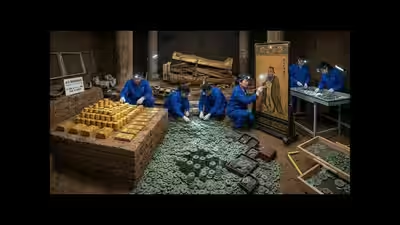
For more than 2,000 years, Liu He was remembered mainly as the emperor who lost the throne almost as quickly as he gained it. He ruled China for just 27 days in 74 BC before being removed and largely written out of imperial history. But when archaeologists opened his tomb in Jiangxi Province, they found something far more enduring than his brief reign: nearly 2 million ancient coins and around 120 kilograms of gold, as per reports.The burial site, known as the Tomb of the Marquis of Haihun, has become one of the most important archaeological discoveries ever made in China. It did more than uncover treasure. It helped reshape the story of a man history had dismissed and gave researchers a remarkably detailed look at the wealth, politics and culture of the Western Han Dynasty.How the tomb was foundThe discovery did not begin as a glamorous excavation. It started with a suspected robbery. In 2011, villagers near Guanxi Village in Nanchang noticed a suspicious tunnel dug into the ground near Guodun Mountain. Archaeologists investigated and found a robbers’ shaft that had burrowed nearly 15 meters underground, reaching the outer wooden chamber of a tomb.That alarm triggered a large-scale rescue excavation under China’s National Cultural Heritage Administration. Over nearly five years, archaeologists worked through nine tombs, a chariot burial pit and the remains of a walled settlement spread across roughly 5 square kilometers. What they uncovered was not just a single grave, but an entire archaeological landscape tied to a vanished elite world, according to Arkeo News.
Image: AI Generated
Who was Liu He?Liu He was the grandson of Emperor Wu, one of the most powerful rulers in Han Dynasty history. He was placed on the throne in 74 BC, but his time as emperor collapsed almost immediately. Court officials accused him of reckless conduct and poor judgment, and he was removed after only 27 days. He was later demoted to commoner status and given the lesser title of Marquis of Haihun, the name by which his tomb is now known.For centuries, that short reign defined him. He was remembered as a failure, someone history had little reason to revisit. Yet the tomb he left behind tells a more complicated story, one that does not fit neatly into the image of a spoiled or careless ruler.What archaeologists foundWhen researchers finally entered the burial chamber, they found what one account described as treasure piled “like a mountain.” The confirmed discoveries were extraordinary. More than 10 tons of bronze wu zhu coins were recovered, amounting to nearly 2 million individual coins, making it the largest hoard of ancient Chinese currency found in a single tomb.The gold collection was equally striking. While early reports inflated the total, the excavation teams later confirmed about 115 to 120 kilograms of gold spread across roughly 480 objects. These included hoof-shaped ingots, gold plaques and gold cakes, and the collection remains the largest and most varied gold hoard ever found in a Han tomb.The tomb also yielded a bronze dressing mirror with what researchers believe is the oldest surviving portrait of Confucius. There were thousands of bamboo slips containing classical texts, including versions of the Analects, Book of Songs, Book of Rites and Spring and Autumn Annals. Outside the main tomb, archaeologists found a horse-and-chariot burial pit, the only one ever discovered south of the Yangtze River.A more complex portraitThe written histories of Liu He describe an immoral, undisciplined ruler whose behavior justified his removal. But the objects buried with him suggest a more layered life. The mirror with Confucius’s portrait, for example, appears to have been both decorative and instructional, reminding the owner of moral discipline every time he prepared himself before a ritual or daily routine.The manuscript collection was especially revealing. Researchers believe the bamboo texts may have been part of Liu He’s own library, carefully stored in the tomb as if to accompany him in the afterlife. One casually inscribed wooden tablet has even been interpreted as a possible personal reading note. That does not erase the historical accusations against him, but it does show that his world included scholarship, ritual and a deep engagement with Confucian thought.Why the discovery mattersThe Haihunhou tomb has become invaluable because it fills in gaps that written history left behind. Archaeologists were able to study not just the grand objects of power, but also the everyday systems of a Han elite burial: how the chamber was laid out, how goods were organized and how ritual beliefs shaped the afterlife.The site is now regarded as the best-preserved Western Han aristocratic burial complex ever discovered in China. That matters because the Western Han was one of the most important dynasties in Chinese history, and this tomb offers a rare, intact window into its political hierarchy, economy and intellectual culture.A decade of studyPublic interest in the tomb grew after Chinese authorities announced major findings in 2015, when the site was named one of the country’s top archaeological discoveries. But the work did not stop there. Researchers continued to analyze the bamboo slips, use infrared scanning to recover faint writing and apply hyperspectral imaging to reveal hidden details on artifacts like the Confucius mirror.A museum built on the site now displays more than a thousand artifacts, allowing the public to see the scale of the discovery firsthand. Even in 2026, Chinese state media were still marking the excavation as an ongoing source of new information about the Han Dynasty.The legacy of a forgotten rulerLiu He ruled for less than a month, and for centuries that seemed to be the most important thing anyone could say about him. But his tomb has changed that. The gold, the coins and the manuscripts buried with him have turned a footnote of imperial history into one of its most studied chapters.In the end, the Haihunhou tomb is more than a treasure hoard. It is a reminder that history often remembers winners loudly and losers badly, until archaeology gives the silent side of the story a voice.
