



For most people, the Sahara is the ultimate symbol of endless sand, scorching heat and one of the harshest environments on Earth. Yet geology tells a remarkably different story. Beneath the dunes lie the remnants of ancient rivers, vast lakes and ecosystems that once supported hippos, crocodiles and thriving human communities. Scientists now know these dramatic transformations were not random events but part of a natural climate rhythm that has reshaped North Africa for millions of years. New research, combined with satellite discoveries and evidence preserved in ocean sediments, is revealing why the world’s largest hot desert repeatedly turned green, how those fertile landscapes lasted for thousands of years, and why predicting the next Green Sahara is far more complicated than simply counting another 20,000 years on Earth’s orbital clock.
Why the Sahara turns green every 20,000 years
As per various reports and MIT News (2019) reveals that the Sahara’s wetter intervals often return roughly every 20,000 years. That figure comes from a long-term movement of Earth known as axial precession, a gradual change in the direction of the planet’s rotational axis. As the orientation of Earth slowly shifts, the timing of the seasons changes in relation to the planet’s position around the Sun. At certain points, northern summers receive stronger sunlight because they occur when Earth is slightly closer to the Sun. That extra heating has consequences far beyond temperature alone. Warmer land across North Africa creates a stronger contrast with the surrounding oceans. This strengthens the African summer monsoon, allowing moist air to travel much farther north than it does today. Rain reaches regions that are now almost entirely dry, supporting vegetation, rivers and lakes across large parts of the Sahara.
How plants help keep the Sahara green for thousands of years
The first increase in rainfall is only part of the story. Once plants begin to spread, they start changing the environment around them. Vegetation darkens the ground compared with pale desert sand, allowing the surface to absorb more sunlight instead of reflecting it away. Plant cover also helps soils retain moisture, while fewer dust particles enter the atmosphere. Lakes and wetlands add further moisture through evaporation, creating conditions that support even more rainfall.These linked processes strengthen the original climatic shift. Instead of rainfall appearing briefly before disappearing again, the landscape can remain wetter for thousands of years while these natural feedbacks continue to operate.A 2023 modelling study led by Edward Armstrong of the University of Helsinki, working with colleagues from the University of Bristol and University of Birmingham and published in Nature Communications, titled, “North African humid periods over the past 800,000 years”, used a newly developed climate model to reproduce roughly 230 North African humid phases stretching back some 800,000 years; one of the first times a model has matched the scale of “greening” that palaeoclimate evidence shows actually occurred. Another study published in Nature Communications, titled ‘Correlation and anti-correlation of the East Asian summer and winter monsoons during the last 21,000 years‘ confirmed the humid periods recurred on a roughly 21,000-year precession cycle, and identified a second key ingredient: large Northern Hemisphere ice sheets. When those ice sheets were extensive, as during glacial periods, they cooled the atmosphere enough to suppress the West African monsoon, so favourable orbital timing alone did not guarantee a green Sahara.
The evidence stretches back millions of years
The Sahara’s repeated transformation is not based on one archaeological site or a single ancient lake. Sediment recovered from the Atlantic Ocean preserves material washed or blown from North Africa over millions of years. Layers rich in windblown dust indicate dry conditions, while sediments delivered by rivers point towards wetter periods. Organic compounds preserved in those deposits also carry chemical signals linked to ancient rainfall.The longest such record comes from a 2022 study led by Anya Crocker (then at the University of Southampton, now at Cardiff University), published in Nature Geoscience, titled ‘Astronomically controlled aridity in the Sahara since at least 11 million years ago’. Analysing dust and river-borne sediment from an Atlantic drill site, the team traced astronomically paced swings between humid and arid conditions in the Sahara back more than 11 million years pushing the record far earlier than the oldest previously known land-based evidence of desert conditions in the region. Elsewhere, cores taken from the Mediterranean contain dark, organic-rich layers known as sapropels. These formed when stronger river systems delivered greater amounts of freshwater into the sea, altering conditions on the seabed. Together, these records reveal repeated alternation between greener and drier Saharan climates. Although the pattern repeats, each humid phase developed under different global climate conditions. Some lasted longer than others, while rainfall reached different areas across the continent.
The last Green Sahara was far from a rainforest
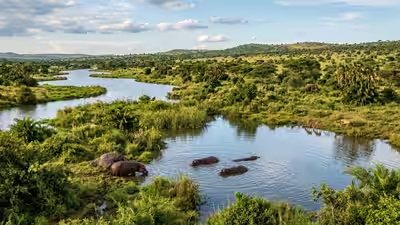
As reported by NOAA, the most recent humid interval, usually called the African Humid Period, began after the end of the last Ice Age. Depending on the location being studied, it lasted from roughly 14,500 until around 5,000 years ago, with the strongest widespread conditions occurring through much of the Holocene.The term “Green Sahara” can create the wrong impression. Large forests did not blanket the desert from one side to the other. Instead, the region contained an ever-changing mix of grasslands, wooded savanna, marshes, rivers, lakes and scattered woodland. Some districts remained comparatively dry, while low-lying basins collected enough water to support extensive wetlands. Rainfall advanced and retreated differently across this vast landscape, producing a patchwork rather than a single uniform environment.Satellite observations and geological surveys have even revealed traces of ancient river systems hidden beneath later sediments. One of the largest, known as the Tamanrasset River, was identified using Japanese radar satellite imagery, reported in Nature Communications in 2015, titled ‘African humid periods triggered the reactivation of a large river system in Western Sahara’. The buried channel from the Atlas and Hoggar highlands in Algeria toward the Atlantic coast off Mauritania, and the study’s authors estimate that in full flow it would have ranked among the world’s dozen or so largest rivers.
Hippos and crocodiles were part of everyday life
Ancient rock art across the Sahara shows giraffes, elephants, cattle and hippopotamuses. These images provide an important glimpse into the wildlife known to prehistoric communities, but archaeology offers stronger physical evidence. Animal remains recovered from the site include hippopotamus bones alongside fish and turtles, indicating that permanent water supported thriving aquatic ecosystems, and radiocarbon dating showed the site was used by two successive cultures across roughly 5,000 years.The sequence records environmental change in remarkable detail. As rainfall gradually declined, fish became less common and communities increasingly relied on domesticated livestock rather than aquatic resources.
The next Green Sahara is not something that can be dated
Earth’s orbital cycles continue today, and precession will eventually produce conditions favourable for stronger northern summer sunlight once again. Even so, that does not allow scientists to predict exactly when another widespread Green Sahara will develop.Orbital changes interact with many other parts of the climate system. Ocean circulation, atmospheric carbon dioxide, vegetation, dust levels, sea-surface temperatures and the presence or absence of large ice sheets all influence how far the African monsoon can expand; a dependence the Armstrong et al. modelling work underscores by showing how ice sheets alone were enough to shut the process down during past glacial periods. Modern human-driven climate change also means future conditions will not simply recreate those of several thousand years ago, even if orbital geometry becomes favourable again.