



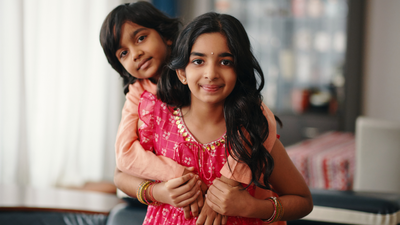
She is often the one everyone can count on. She notices when her mother is stressed, keeps an eye on younger siblings, helps around the house and rarely asks for much herself. People call her “mature,” “sensible,” or “the responsible one.” But sometimes, what looks like maturity is actually a child learning to carry adult responsibilities far too early.Psychologist and intergenerational trauma expert Dr Mariel Buqué recently discussed this dynamic on The Mel Robbins Podcast. The psychologist describes the eldest daughter as “the prototypical parentified child”- someone who “takes on a lot of the family burdens” and often has to “act as a parent to younger siblings well before a time when she’s ready to parent.”
28 Jul 2026 | 16:25
Do you think social media has changed the parent-teen relationship?
The term is important because being the eldest daughter is not itself a psychological problem. Nor is helping with siblings or contributing to household chores. The concern begins when a child’s responsibilities consistently go beyond what is age-appropriate, particularly when she starts feeling responsible for the family’s emotional or practical wellbeing.
When a child becomes the ‘little adult’
Imagine a parent working long hours or juggling multiple jobs. The eldest daughter starts feeding her younger siblings after school, helping them with homework and putting them to bed.At first, it may simply be what the family needs to get through a difficult period. But if the pattern continues, the child may begin to occupy a role that belongs to an adult. Reflecting on this dynamic, Dr. Buqué asks a question that captures the hidden cost of growing up too soon: “Who’s tucking her in? Who’s feeding her? Who’s nurturing her? Who’s taking care of her?” The point, she says, is that while the eldest daughter may be caring for everyone else, her own need for security and dependence can quietly go unmet.

File Photo: Canva
A 2023 mixed-methods systematic review examined 95 studies from around the world and found that parentification can have both positive and negative outcomes. Some young people develop coping skills and a sense of competence, but others experience emotional difficulties, behavioural problems and poorer physical or psychological wellbeing. The researchers also stressed that the impact depends on factors such as the child’s circumstances, perception of the responsibility and availability of support.In other words, helping at home isn’t automatically harmful. Being expected to carry the family is different.
Why asking for help can become so difficult
One of the most interesting points in Buqué’s discussion is what can happen when a child repeatedly learns to put her own needs aside. If nobody regularly asks what she needs, she may never become comfortable expressing those needs. As Dr. Buqué puts it, “She never learned the language of her own needs.” That pattern, she explains, can carry into adult relationships, friendships and the workplace, where asking for support or expressing personal needs may feel surprisingly difficult. She may find it easier to say, “Don’t worry, I’ll handle it,” than, “I need help.”But it is important not to turn every responsible eldest daughter into a case of childhood trauma. Research does not support such a simple conclusion. Parentification exists on a spectrum, and the surrounding circumstances matter enormously.
What parents can do differently
The answer isn’t to stop children from helping. Children benefit from having responsibilities. Chores can teach independence, cooperation and competence. Older siblings can certainly help younger ones.The goal is to make sure helping does not become parenting.
- Give children responsibilities, not adult burdens
Ask yourself: If my child says no today, can I still manage?
If the household cannot function without the child regularly stepping in, the responsibility may have become too heavy. - Don’t make a child responsible for your emotions
Children can know that parents have difficult days. But they should not feel that it is their job to make the parents feel better. - Let the eldest child have needs too
Sometimes parents become so accustomed to the “capable” child that they forget she still needs nurturing. Ask her: “Do you need help?” “Do you want to take a break?” And sometimes, simply take over. A child should experience being cared for, not just being useful. - Watch for the family mediator
If siblings argue, the eldest child shouldn’t always be expected to resolve it. If parents disagree, she shouldn’t become the messenger between them. Adults need adult support. Children need permission to remain children.
File Photo: Canva
And if you recognise yourself in this? For an adult who sees these patterns in herself, the answer isn’t necessarily to blame her parents. Families often fall into these dynamics because of financial hardship, parental absence, illness or circumstances in which adults simply don’t have enough support.The bigger parenting lesson is perhaps this: raising a responsible child should not require sacrificing her childhood. An eldest daughter can be caring without becoming the caregiver. She can be dependable without becoming the family’s fixer. She can learn strength without believing she must always be the strong one. Dr. Buqué says, can mean learning to “receive without guilt”- a reminder that caring for others should never come at the cost of forgetting how to let others care for you too.
