


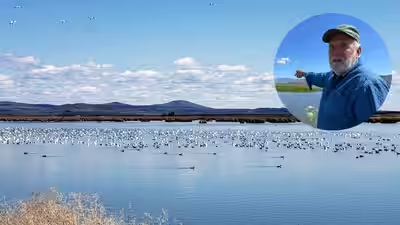

A farmer in southern Oregon transformed 70 acres of his 400-acre barley farm into a wetland in 2021, creating an unexpected refuge for wildlife while helping address agricultural water pollution. Karl Wenner, a co-owner of Lakeside Farms near Klamath Falls, worked with conservation agencies and other partners to convert flood-prone farmland into a managed wetland. The area now attracts tens of thousands of ducks, geese and swans and supports at least 140 bird species, along with otters, beavers and muskrats. More significantly, the wetland has been used to raise federally endangered Lost River and shortnose suckers. In 2025, researchers found 50 adult-sized suckers after partially draining the wetland, offering a promising sign for species struggling with poor juvenile survival.
Why an Oregon farmer turned 70 acres of his barley farm into a wetland
Wenner became a co-owner of Lakeside Farms in 2017. The roughly 400-acre property had traditionally been used to grow barley and sits near Upper Klamath Lake, an important wetland and waterbird habitat in southern Oregon. Wenner initially appreciated the farm because its abundant water attracted ducks, but he later became concerned about the quality of water leaving the agricultural land. Tests showed that the water carried high concentrations of phosphorus, a nutrient that can contribute to harmful algal blooms in Upper Klamath Lake. Instead of continuing to farm the most flood-prone portion of the property, Wenner and his partners explored whether the land could be used to naturally filter agricultural runoff while providing wildlife habitat.The restoration project began taking shape in 2021, when about 70 acres of the farm were converted into a semi-permanent wetland. The area was engineered with shallow water areas, channels, dikes and islands that allow water to move slowly through the site. Rather than flowing directly towards Upper Klamath Lake, agricultural water can pass through the wetland, where vegetation and sediments capture nutrients and suspended material. The project was designed to provide environmental benefits without requiring the entire farm to be taken out of agricultural production. The remaining land continues to be used for farming, making the project an example of how restoration and agriculture can operate alongside each other.Wildlife responded quickly after the wetland was established. US Fish and Wildlife Service records documented more than 20,000 ducks using the property during October and November. Later reporting found that the restored area had attracted tens of thousands of ducks, geese and swans, while at least 140 bird species had been recorded at the farm. The wetland also became home to other wildlife, including otters, beavers and muskrats. Its rapid development into a productive habitat is particularly notable because the area had previously been used primarily as agricultural land.

Why an Oregon farmer turned 70 acres of his barley farm into a wetland
Plant diversity also increased
The ecological changes were not limited to birds and mammals. Researchers used pollen collected by bees to study plant diversity around the farm. The analysis indicated that plant biodiversity had doubled within two years of the wetland restoration. Bee-based monitoring also helped identify native plants growing around the property and highlighted invasive species that could be targeted for removal. The approach gave researchers another way to measure how the landscape was changing as agricultural fields were replaced, at least partly, by wetland habitat.
The wetland became a refuge for endangered fish
The project also took on significance for two endangered fish species found in the Klamath Basin. The Lost River sucker and shortnose sucker are both federally listed as endangered and are culturally important to the Klamath Tribes. Their populations have declined dramatically, with poor survival of young fish contributing to the difficulty of rebuilding their numbers. Conservationists therefore need places where juvenile suckers can survive and grow before eventually joining the wider lake population. Parts of the Lakeside Farms property were modified to provide such habitat, creating a protected environment that could serve as a nursery for the fish.
Thousands of young suckers were introduced
As part of the conservation work, young suckers were introduced into ponds on the farm. Different releases and accounts have recorded varying numbers, with the broader project involving several thousand juvenile fish. The fish included endangered Lost River and shortnose suckers as well as native Klamath largescale suckers. The aim was not simply to increase the number of fish on the farm but to determine whether restored wetland conditions could allow young suckers to survive and develop in an environment resembling the shallow habitats that historically existed around Upper Klamath Lake.
Researchers found 50 adult-sized fish
A particularly significant development came in May 2025, when researchers partially drained the wetland to assess how the stocked fish had fared. They found 50 adult-sized suckers, with some measuring up to about 16 inches. The recovered fish appeared healthy and had reached a size comparable with mature fish. Researchers cautioned that the sampling might not have captured every fish in the wetland and that genetic testing was needed to determine the precise species composition of the recovered fish. The discovery nevertheless provided evidence that at least some stocked suckers had survived and grown substantially in the restored habitat.The discovery is important because the Klamath Basin’s sucker populations face a serious recruitment problem. Many young fish fail to survive long enough to become adults, leaving existing populations dominated by older fish. Poor water quality, habitat loss, altered water flows and other environmental pressures have contributed to the decline. The Lakeside Farms project does not solve those wider problems, nor does the discovery of 50 adult-sized fish prove that a self-sustaining population has been established. It does, however, suggest that restored wetlands on working agricultural land could provide valuable rearing habitat for young suckers.
The wetland also helps clean agricultural water
Wildlife restoration was only part of the project’s purpose. The wetland was also designed to improve the quality of water leaving the farm. Excess phosphorus entering Upper Klamath Lake can contribute to nutrient pollution and harmful algal blooms, which can create difficult conditions for aquatic life. By slowing water and allowing plants and sediments to absorb or retain nutrients, the wetland acts as a natural treatment system before water reaches the lake. Reports on the project indicate that phosphorus levels in water leaving the wetland were substantially reduced, demonstrating how agricultural land can potentially be used to address some of the environmental impacts associated with farming.
A different model for farmland restoration
The project has attracted attention because the land has not simply been permanently removed from agriculture. Some fields can be managed as wetlands for periods before potentially returning to crop production. Flooding can also help suppress weeds and pests and may improve soil conditions. Wenner and his partners have therefore been testing whether farmers can receive ecological benefits while retaining an economically viable agricultural operation. Other landowners in the Klamath Basin have reportedly shown interest in similar approaches, suggesting that the experiment could eventually be replicated elsewhere.
A project built on collaboration
The transformation was not carried out by Wenner alone. Lakeside Farms worked with federal and local conservation organisations, including the US Fish and Wildlife Service and Klamath Watershed Partnership. Funding and technical support helped with the wetland’s design, construction and ongoing management. The project also brought agricultural interests into closer contact with conservation efforts involving the Klamath Tribes and endangered sucker recovery. That collaboration is significant in a region where disputes over water, farming and endangered species have persisted for decades.
The wider Klamath Basin challenge
The significance of the farm becomes clearer when viewed against the history of the Klamath Basin. Large areas of the region’s historic wetlands have been lost or altered, while agriculture has changed the way water moves through the landscape. Upper Klamath Lake remains an important habitat for migratory birds but also faces persistent water-quality challenges. The two endangered sucker species have suffered severe population declines, making the creation of additional shallow-water habitat particularly valuable. Against that backdrop, a 70-acre wetland may be relatively small, but it offers a practical demonstration of how individual farms can contribute to broader restoration efforts.
A small farm experiment with a bigger possibility
The Lakeside Farms project began with a relatively simple question about what to do with flood-prone farmland and polluted agricultural water. Four years after the wetland was created, the results had extended far beyond water treatment. Tens of thousands of waterfowl were using the property, at least 140 bird species had been recorded, plant diversity had increased and endangered suckers had survived to adult size. The project is not a complete solution to the Klamath Basin’s environmental problems, but it demonstrates how a working farm can be redesigned to provide food, habitat and cleaner water at the same time.
