


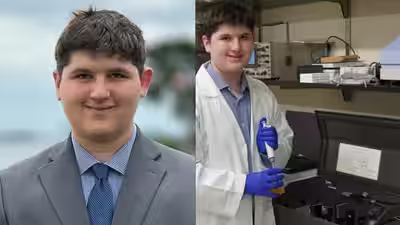
Justin Bernstein, a 17-year-old student from Greenwich, Connecticut, has developed a research project exploring how genetically engineered bacteria could help slow Arctic ice melting. Named a 2025 Davidson Fellow in the science category, he received a $50,000 scholarship for his work on engineering Cryobacterium to produce reflective silica, potentially helping glaciers absorb less solar energy. His project, titled “Implementation of Bioengineered Cryobacteria to Enhance the Glacial Albedo of Arctic Ice to Reverse Climate Change-Induced Rise in Sea Levels”, uses climate modelling to examine the potential impact on ice loss and rising sea levels. Bernstein is an incoming first-year student at Yale University.
How Bernstein’s research uses ice-albedo feedback to slow Arctic glacier melting
Arctic ice plays a role in regulating how much solar energy the Earth’s surface absorbs. White ice and snow reflect a substantial proportion of incoming sunlight, whereas darker surfaces, including exposed ocean water, absorb more energy. As ice melts and darker surfaces become exposed, the additional absorption of solar energy can contribute to further warming and melting. This process is known as the ice-albedo feedback.Bernstein’s project focuses on this feedback mechanism. Rather than addressing climate change solely through measures aimed at reducing greenhouse gas emissions or removing carbon dioxide from the atmosphere, his research explores whether increasing the reflectivity of glacier surfaces could help slow ice loss. The Davidson Institute’s project description explains that the approach is intended to make glaciers more reflective so they absorb less heat and melt more slowly. The research therefore examines a potential intervention aimed at one of the physical processes that can accelerate the loss of Arctic ice.
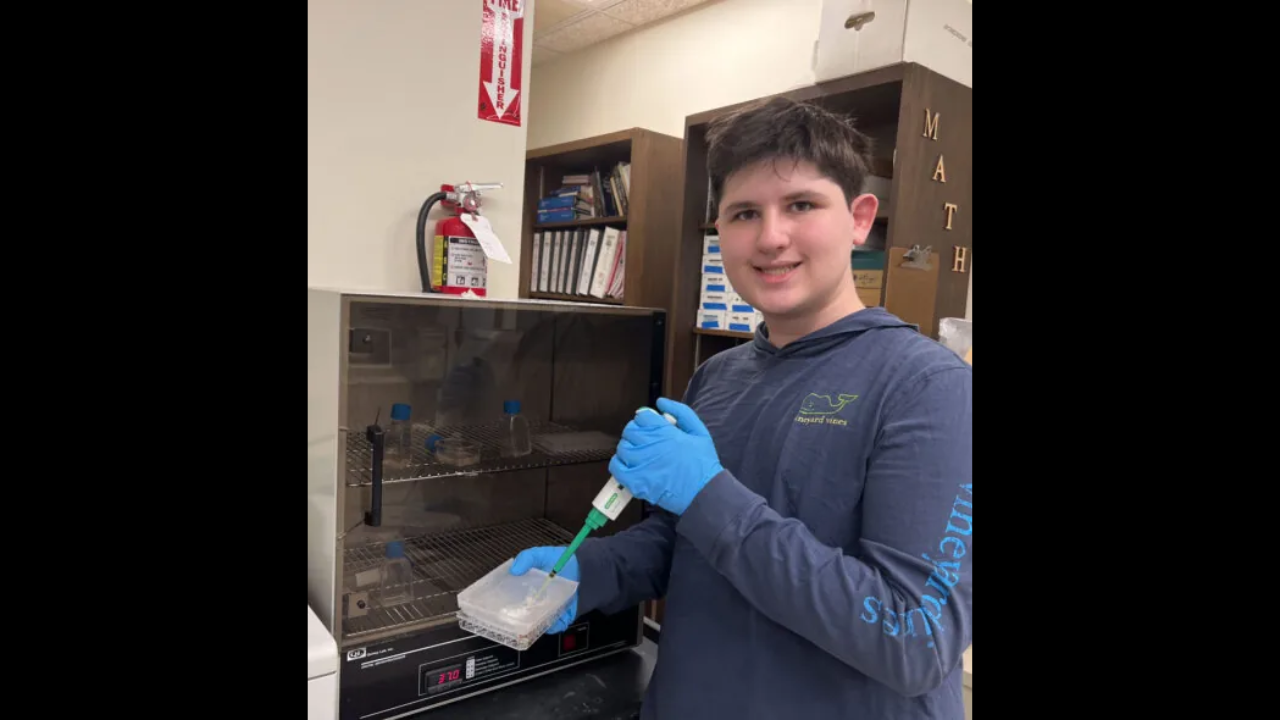
PC: Davidson Institute’s account of the research
How Bernstein engineered bacteria to produce reflective silica
Bernstein’s research uses genetically engineered Cryobacterium, a type of bacterium associated with cold environments, to produce silica, a material used in glass. The project incorporates genes from diatoms, a group of algae that naturally produce silica structures. The intended result is a biological system capable of generating reflective silica using dissolved silicon already present in the surrounding environment.According to the Davidson Institute’s account of the research, the bacteria could be applied to glacier surfaces, where the silica they produce would help reflect sunlight. The proposed mechanism is to reduce the amount of solar energy absorbed by the ice and consequently slow melting. The project description also states that the bacteria could reproduce independently and continue producing silica through repeated melting and freezing cycles. These characteristics form the basis of Bernstein’s proposed approach to maintaining the reflectivity of glacial surfaces without requiring continuous industrial intervention.
How Bernstein’s bacteria-based method differs from silica microbeads
Bernstein’s bacterial approach with the use of silica microbeads, which have previously been considered as a way to increase surface reflectivity. According to the Davidson Institute, these microbeads can be expensive, short-lived and ecologically invasive. Bernstein’s proposed method instead seeks to use an engineered biological system that produces silica from naturally occurring dissolved silicon.The approach is presented as potentially low-cost and self-sustaining because the bacteria could reproduce and continue generating the reflective material after introduction to the glacial environment. However, these are characteristics of the proposed research approach, rather than evidence that the technique has already been deployed successfully across Arctic glaciers. The Davidson Institute’s profile describes the project and its modelling results, but does not establish that the intervention has been implemented at a scale sufficient to reverse real-world glacier loss.
How Justin Bernstein’s model predicts Arctic ice gains
Bernstein’s project includes climate modelling to examine how increasing glacial reflectivity could affect ice loss. His simulations suggest a potential change from the current net loss of (9.6 \times 10^9) square metres of ice annually to a gain of (2.80 \times 10^9) square metres per year. The research presents this projected change as a possible outcome of applying the proposed intervention.The implications of preserving glacial mass for sea-level rise. By reducing the amount of ice lost, the proposed method could potentially help limit one contributor to rising sea levels and reduce flooding risks for coastal communities. These figures are modelling results reported in the institute’s profile, rather than measurements of an observed change in Arctic ice cover. The profile does not provide sufficient methodological detail to independently assess the simulations or establish that the projected gains would occur under real-world conditions.
Why Bernstein pursued a biological approach to ice preservation
Bernstein’s interest in the subject was influenced by his experiences in his coastal community, where he observed flooding on roads and pressure on local infrastructure. He explained in his project description that these experiences motivated him to investigate a solution with both local and global relevance.His research considers how biological systems might complement other climate measures. While emissions reduction and climate policy remain important approaches to addressing global warming, the project explores a way to intervene directly in a feedback mechanism associated with ice loss. Its proposed use of engineered bacteria is intended to preserve the reflective properties of ice while longer-term climate measures take effect. The work consequently examines a potential application of biotechnology to an environmental challenge involving glaciers, sea-level rise and coastal vulnerability.
What the research could mean for coastal communities
Rising sea levels can increase the risk of flooding in coastal and low-lying areas, with consequences for infrastructure, freshwater supplies, property and local economies. Bernstein’s research proposes that slowing glacial melt could help reduce some of these risks by limiting ice loss.Possible wider benefits associated with preserving glacial mass and limiting additional warming, including effects on agriculture, extreme weather risks and long-term water security. These outcomes remain potential implications of the proposed approach. The available profile does not establish that the engineered bacteria have already reduced sea-level rise, prevented flooding or produced measurable improvements in these areas. The research instead presents a possible method of addressing one component of the processes contributing to climate change.
Bernstein’s research and recognition as a 2025 Davidson Fellow
Bernstein received a $50,000 scholarship after being selected as a 2025 Davidson Fellow in the science category. The Davidson Institute recognises students aged 18 and under through its fellowship programme, which supports young people undertaking significant work in fields including science, technology, engineering and mathematics.His other achievements include winning the United States competition for the Stockholm Junior Water Prize and earning a gold medal at the international Genius Olympiad, according to his Davidson Institute profile. Beyond research, Bernstein volunteers as an Emergency Medical Technician, serving on community ambulances and organising outreach events to introduce children to ambulances and help prepare the community for medical emergencies. He also teaches younger students about the scientific research process, with an emphasis on encouraging curiosity and critical thinking.Bernstein has described the fellowship as motivation to continue using science to develop solutions to environmental and public health challenges. His project on bioengineered bacteria and glacial reflectivity explores how biotechnology could contribute to climate research.
